

Price communication is a central part of e-commerce, but in June, two well-known companies stumbled and were convicted of misleading marketing.
Outnorth sent a text message with an enticing membership offer to its customers. The message stated that the customer would receive a 25 percent discount on a purchase if they were or became a member. But for those who clicked on the link in the message, a different reality awaited.
It turned out that the discount only applied to purchases of two items, each of which had to cost at least 699 Swedish krona. A private individual noticed the terms and reported the mailing as misleading.
Outnorth agreed with the complainant's assessment.
The marketing can be misinterpreted in this case. We have failed in our routine and will immediately rectify this in our processes regarding clarity in SMS messages and ensure that our internal policy is followed regarding clearly referring to the terms of membership offers, Outnorth stated to RO.
The Advertising Ombudsman pointed out in its assessment that each advertising unit should be assessed individually. The clarifying information behind the link could therefore not save the mailing.
The conclusion was that an average consumer likely perceives the text in the SMS as the discount applying without any conditions, which made the advertisement misleading.
Two People Reported Mathem
A similar transgression regarding price and terms led to the online grocery giant Mathem being convicted. In an advertisement published on Expressen's website, Mathem showed a bunch of bananas along with the headline that they were now equally the cheapest for everyday life. Below the headline was text stating that they had the same price as in the store, but without going to the store. In the middle of the advertisement, a black sticker was placed indicating a price match on over 500 items.
Two private individuals reacted and reported the campaign. One argued that the word "cheapest" gave a false impression that Mathem's entire range was the cheapest in everyday life. The other pointed out that the advertisement concealed that the comparison only applied to a few selected stores.
Mathem contested the report and explained its strategy for word choices:
By using the wording, we use the word "lika" (equal) as a direct modifier to the superlative "cheapest." This means that we are not claiming exclusive price leadership, but communicating a price parity with the cheapest alternatives on the market for relevant everyday purchases.
Mathem also emphasized that the limitation on over 500 items was clearly visible directly in the advertisement and not hidden behind a click, and that these items represented a normal everyday shopping trip for a family with children.
The Opinions Board, however, did not agree with Mathem's line of reasoning.
The board determined that the message was unclear and ambiguous. It did not clearly state whether the price match applied to competitors' prices in physical stores and online, or whether it concerned price reductions compared to Mathem's own previous prices. The advertisement was therefore convicted of being misleading.
Unhealthy Ideals and Objectification in Focus
The second major area in the June reports concerns how human bodies are exposed and portrayed in e-commerce imagery. Several companies were convicted here for both gender discrimination and a lack of social responsibility.
H&M received a double conviction in June regarding images depicting extremely thin models, which the Opinions Board believed could contribute to unhealthy and harmful ideals. The first report concerned a product page on the site where a young woman posed in a short halterneck dress. Her pose and styling highlighted a very thin upper arm and her collarbones, which caused a complainant to react that the model looked thin.
H&M acknowledged the shortcomings regarding the specific image.
Our ambition is for images to present collections and products in a way that inspires and is relevant to customers in our many markets around the world; the purpose is never to convey or reinforce a particular body ideal. After reviewing the current image in connection with the report, we note that it does not live up to our ambition and that we have failed in terms of, among other things, photo angle and styling, H&M stated.
The company removed the image and replaced it. Despite this, the case was reviewed by the Opinions Board, which found that the model was portrayed in a way that gave the impression that she was extremely thin.
Shortly thereafter, H&M was convicted again for the same reason.
This time it concerned a black and white mobile advertisement for a smocked top within the denim campaign. The model sat outdoors with bare arms and prominent collarbones. H&M argued in this case that the image showed a natural pose and did not convey an unhealthy message, but the Opinions Board disagreed. This advertisement was also convicted of being designed without due consideration for social and professional responsibility.
Protein.se Was Supposed to Show Skin Tone – Reported for Objectification
The boundary between product focus and sexualization was tested during the month. Protein Com was convicted for a Facebook advertisement for sunless tanning capsules. The advertisement showed a woman wearing a small bikini top, cropped so that her face is not visible. The image focused on the difference between the reddish-brown skin and the white skin under the bikini.
The complainant considered the advertisement to be objectifying and focused on a woman's breasts rather than the product. Protein Com replied that the purpose was to show a tan line, but admitted that the design was not fully thought through.
The intention was to show a result related to skin tone, not to sexualize or objectify the person in the image. At the same time, we understand that the chosen cropping, where the face is not visible and the upper body is given a prominent focus, can be perceived as objectifying, Protein stated in its response.
RO assessed that showing bare skin in itself had a connection to a sunless tanning product. But the combination of clothing, pose and cropping went beyond what was justified for the product. The advertisement was convicted as gender discriminatory and degrading to women in general.
Gina Tricot Won One But Lost Another
A similar case affected fashion giant Gina Tricot. A post on Facebook, produced by and featuring an influencer, showed a yoga set with leggings, a cardigan and a low-cut top. The image was cropped just below the chin and focused on how the influencer tied the wrap cardigan in a bathroom.
A private individual reported the post for showing an unhealthy body ideal and for being sexist.
Gina Tricot defended the image by stating that all three garments needed to be visible and that the influencer posed in a neutral environment in a way that is common in the advertising industry.
The Opinions Board acquitted Gina Tricot regarding thinness and body ideal, as the model did not appear extremely thin in an overall assessment. However, the post was convicted of gender discrimination.
The board considered that the pose and cropping created a sexualized focus on the bust that was not justified when selling yoga clothes.
Amanda Schulman's Mistake on Social Media
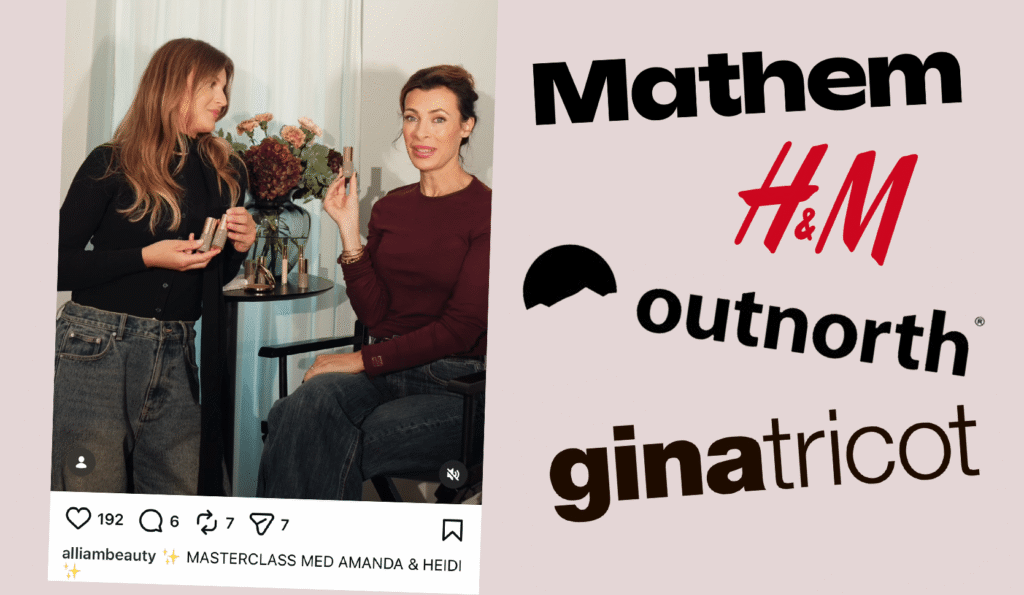
Clearly showing what is advertising is a basic requirement, especially on social media where private and commercial content is easily mixed. In June, We are Beauty, the company behind the brand All I AM Beauty where profile Amanda Schulman is a part-owner, was convicted.
The report concerned a 30-minute video on Amanda Schulman's Instagram account. In the video, she and a colleague presented a foundation stick, how the formula had been tested and how the product is best applied. However, the post lacked a clear advertising marking.
The company defended itself by stating that the post was shared via a collaboration function on Instagram and that the commercial purpose was obvious to the audience.
The intention of the post has been to communicate information about the company's own products in a transparent manner. In the video, the company is consistently referred to as "we" and the products as "our products," in order to clarify that the communication takes place from the company and within the framework of its own business operations, We are Beauty wrote in its response.
The company also announced that it has now tightened its guidelines to use a more consistent advertising marking in the future.
RO was clear in its decision: a post must be identifiable as advertising directly at a quick glance. The fact that the profiles in the video talk about "we" and "our products" was not enough for the average consumer to immediately understand that it concerns marketing. The post was convicted of not meeting the requirement for advertising identification.