

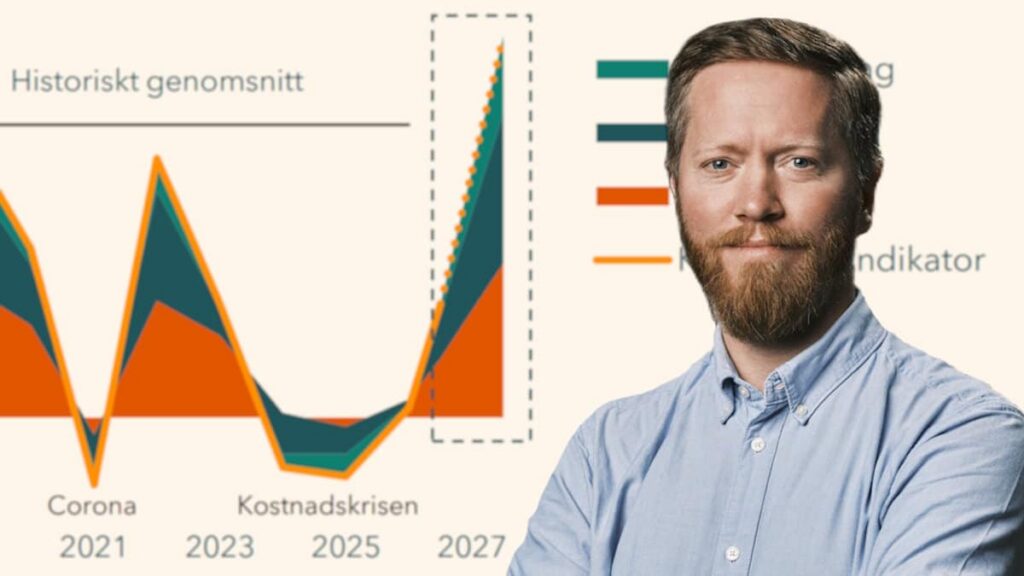
The Small Business Barometer, conducted by Företagarna, Swedbank and Sparbankerna, is based on responses from over 7,000 small business owners and shows a clear upward turn. Expectations for the next twelve months are now above the historical average. Wholesale and retail trade, which has experienced a weak current situation with a net total of 23 for the past twelve months, is seeing a significant increase where the future indicator rises to a net total of 91. Together with the service sector and industry, trade is therefore one of the most optimistic industries, says Jörgen Kennemar, business economist at Swedbank:
The recovery has now had a clear impact on the daily lives of small businesses. We are seeing more companies receiving new deals, turnover is increasing and profitability is strengthening. This creates conditions for investments and new hires in the future.
The report further shows that more companies are seeing increased sales. A full 37 percent state that profitability has improved over the past year, and 24 percent plan to hire new employees in the coming year. At the same time, new challenges are emerging as demand increases. Labor costs and skills shortages are identified as the main obstacles to growth, with 15 percent citing difficulties in finding personnel as the biggest obstacle.
Karl Ernlund, chief economist at Företagarna, clarifies however that optimism must be met with political reforms:
Small businesses have fought their way through several years of cost crises and weak demand. Now they dare to believe in the future again, but optimism does not create growth on its own. For future confidence to become more jobs and investments, politics must lower the barriers to employment and give companies better conditions to grow.
Tailwind for e-commerce
The increased optimism is in line with recent reports from the trade sector as a whole. In September, Svensk Handel's Trade Barometer showed a clear turnaround for trade with the strongest future confidence since 2021.
At the same time, new statistics confirm changes in consumer behavior. PostNord's E-barometer recently showed that Swedish consumers are increasingly choosing to abandon foreign low-price platforms in favor of domestic e-commerce retailers, which has resulted in increased average amounts at Swedish online stores.