

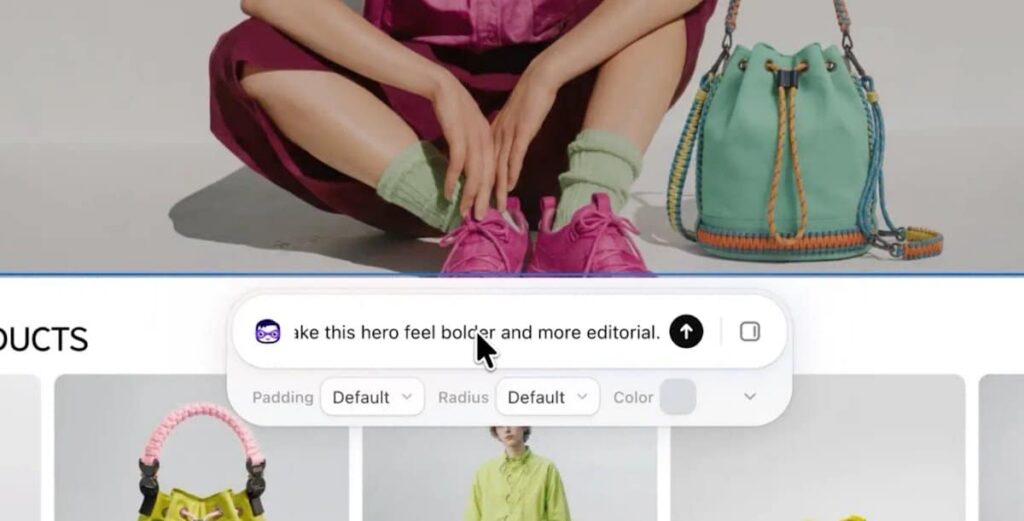
According to the company, the function will allow users to create a customized online store regardless of prior experience with coding or design.
When I built Kotn twelve years ago, I knew how to code, and it still took me two weeks to get a rough store up and running. Today, an entrepreneur on Shopify can build a fully customized store in twenty minutes,” says Ben Sehl, Product Manager at Shopify.
Further Development of Previous Systems
This launch serves as a direct further development of the AI tools that the platform introduced in 2025. Previously, "AI Store Builder" was launched, a tool that allowed users to generate the first draft of a store based on a short description and keywords. Sidekick was also introduced at the time with features for voice chat and data analysis. Now, Sidekick has been expanded to directly edit theme files and recode entire store structures. The agent takes its own screenshots to review its work before presenting the result to the merchant. Austin Knight, Design Manager at Shopify, explains that it was relatively easy to get the AI to write code, but it took more time to steer it towards making consistent design decisions.
Cross-Industry AI Trend
The focus on integrating artificial intelligence into core operations is not isolated to Shopify. The same pattern is seen among merchants using other e-commerce platforms. E-commerce entrepreneur Dan Nilsson, who recently launched the online store Bangerpack on the Quickbutik platform, has built his new business with extensive AI integration. For him, the AI model Claude serves as the central engine for the company.
When purchasing and researching, I get ten times more done today than before. My entire catalog and all content is managed via Claude, I hardly work in my own email anymore,” says Dan Nilsson.
The development demonstrates that AI in e-commerce now encompasses the entire chain. In addition to platforms like Shopify building in design assistance for the front-end, merchants are using artificial intelligence to automate logic in the background. Dan Nilsson has, for example, set up his own flows where AI creates discrepancy reports for incoming invoices and monitors purchase orders. Regardless of which system the e-commerce businesses choose as a platform, it seems that artificial intelligence is now deeply integrated into daily processes.