

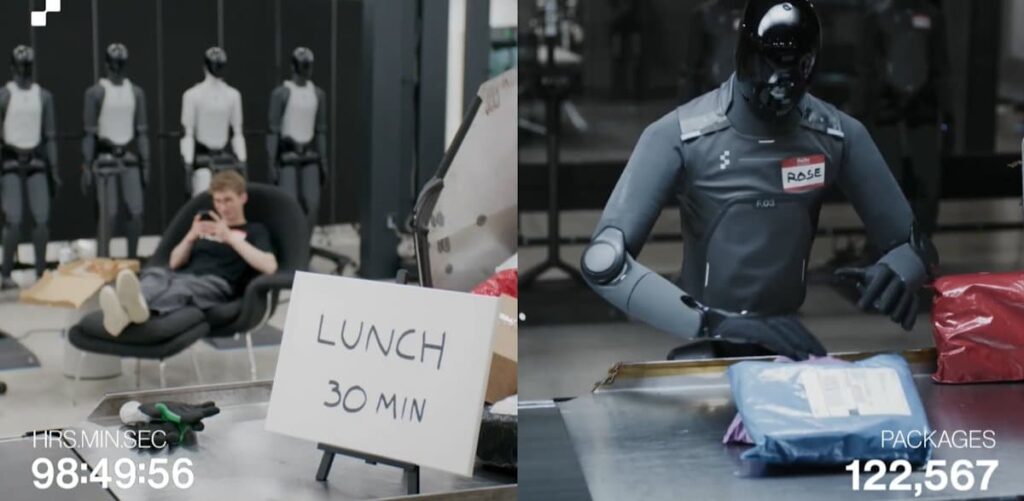
Robot company Figure AI, valued at $39 billion, initially began its demonstration to show that their new model, Figure 03, could work autonomously for eight hours. The task consisted of inspecting barcodes on various types of shipments and placing them on a conveyor belt with the code facing down.
The demonstration, which has been running around the clock for eight days at the company's headquarters in San Jose, has currently resulted in approximately 230,000 sorted packages.
Competition Over Ten Hours
Over the weekend, the test was extended by having Figure AI intern Aimé Gérard compete against one of the robots. The competition lasted for ten hours, with Gérard taking regular breaks for meals and rest in accordance with California labor law.
When the shift was over, Gérard had sorted 12,924 packages, which was 192 more than the robot's 12,732 packages. The average time per package landed at 2.79 seconds for the intern and 2.83 seconds for the robot.
This is the last time a human will ever win, wrote Figure AI CEO and founder Brett Adcock on X after the competition.
The Technology Behind The Operation
The robots are controlled by the company's neural network Helix 02. The system runs locally on the hardware and is said to be trained on over 1,000 hours of human motion data as well as in simulated environments.
To enable continuous operation, the robots are connected in a network. When a battery starts to run low, which happens after three to four hours, or if a technical fault occurs, the robot can autonomously call for a replacement from a charging station to take over the position at the conveyor belt.
Challenges With Precision
Despite the system demonstrating the ability to keep running for long periods, experts point out that the technology is not yet ready for widespread implementation in the logistics sector. Viewers of the live broadcast have noted that the robots occasionally drop packages, grab at air or place shipments with the barcode facing the wrong way.
We are a long way from a fully autonomous humanoid in a logistics center, said Ayanna Howard, head of Ohio State University's engineering faculty.
Figure AI previously tested its previous model, Figure 02, in an eleven-month pilot project at BMW in South Carolina, where the machines handled sheet metal parts. Whether the current model, Figure 03, will move on to live customer assignments within logistics remains to be seen.