

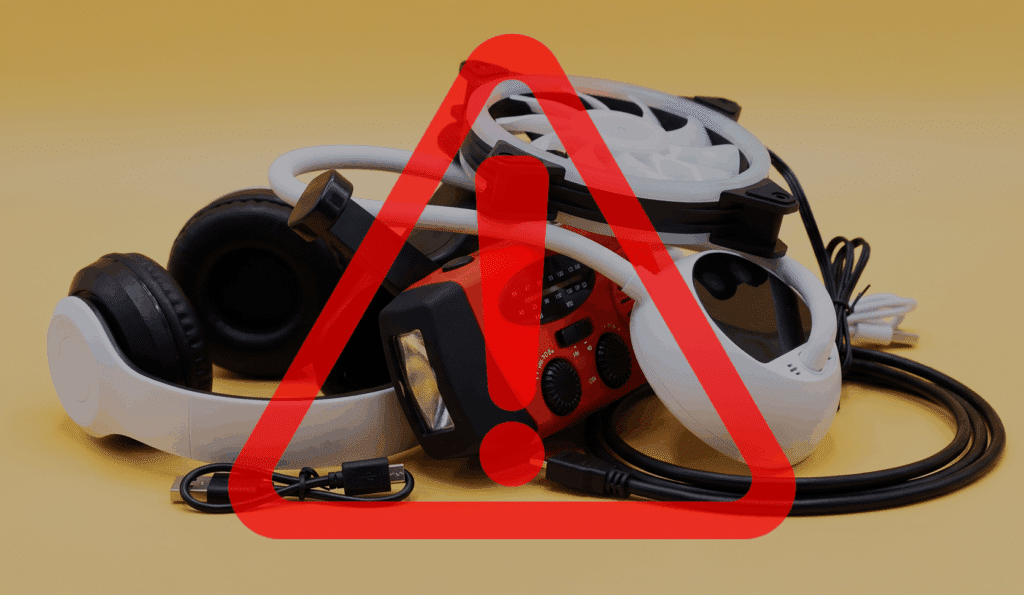
The Swedish Chemicals Agency has conducted an inspection of home electronics in 2025, examining just over 200 products. The results show that 30 percent of these contained substances that violate current legislation. This is not a temporary dip but a trend that has persisted for the past five years.
It is the cheap electronics that account for the most deficiencies. The fact that the problems remain at the same level year after year is remarkable, says Marcus Hagberg, inspector at the Swedish Chemicals Agency.
Lead and Hidden Plasticizers
The substances most often found in the products are heavy metals and various types of plastic additives. Lead tops the list of the most common prohibited substances, but inspectors also found plasticizers such as phthalates and flame retardants in the form of chlorinated paraffins.
Although a single charging cable or a lamp does not pose an immediate hazard during use, they contribute to a cumulative exposure in the everyday environment that can have effects in the long term. In addition to the health aspect, these chemicals create major obstacles when the products are eventually discarded. When electronics containing prohibited substances end up in the waste system, it becomes more difficult to recycle materials in a sustainable manner.
The Problem with CE Marking
One of the most critical points in the review concerns the labeling that is supposed to guarantee that a product is safe for sale within the EU. For many electronic products, no testing by an independent party is required. Instead, the manufacturer makes an internal assessment that the goods meet legal requirements and then applies the marking. Statistics from the inspection show that this system leaves room for inaccuracies. Among the products that proved to have deficiencies, more than 80 percent were marked with just this marking.
It is a worrying result, but our recommendation is still to choose CE-marked products. The marking is not a guarantee, but electrical products without CE marking are not allowed to be sold on the EU market, says Marcus Hagberg.
The Demand on Companies
The authority has already initiated new inspections to continue mapping the product groups where the problems are greatest. For companies that import goods into the EU, the results mean that control of the supply chain is becoming increasingly important. Relying on superficial guarantees is not enough: knowledge of legal requirements and direct demands on factories are necessary tools to reverse the trend.
For those who shop online, the low price is often the clearest warning sign. Choosing more established brands can be a way to reduce the risk of receiving goods with unauthorized chemicals.
For the situation to improve, a great responsibility rests on importing companies. They need to set clearer demands on their suppliers and have good knowledge of the legal requirements that apply, says Marcus Hagberg.