

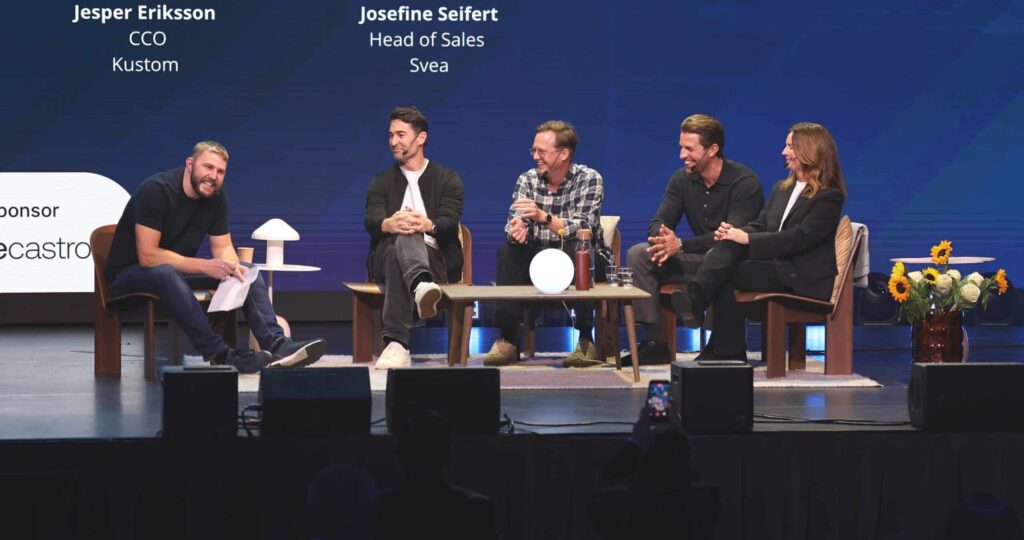
The checkout is the e-commerce merchant's most sacred space, but also a constant battleground surrounding transaction fees, customer data, and conversion rates. During a panel debate, four heavyweights from the payment industry were put on the spot: Josefine Seifert from Svea, Tomas Bromander from Avarda, Jesper Eriksson from Kustom, and Josef Bosaeus from Walley.
The debate was moderated by Joel Löwenberg, CEO of Gymkompaniet, who immediately set the tone by representing the harsh reality for Swedish e-commerce merchants. While the payment companies were eager to steer the conversation towards how they help merchants grow, Joel Löwenberg relentlessly pushed the focus back to the price tag.
When asked how much better terms an e-commerce merchant with a turnover of 100 million kronor receives compared to one with a turnover of 10 million, Svea's sales director Josefine Seifert emphasized that volume is not everything.
Of course, you have a better negotiating position if you turn over 100 million instead of 10, but it’s important to remember that biggest isn’t always cheapest. When we assess the price, it’s so much more than turnover. It's the distribution of payment methods that's important, as well as the potential in the deal, said Josefine Seifert.
She explained that payment companies are much happier when customers choose invoice or installment payments rather than direct payments, and argued that e-commerce merchants are focusing too much on the transaction cost.
Rather ask us payment providers how much more can I sell if I choose you as a payment provider? I think that’s more important than price, because the cheapest payment solution isn’t always the most profitable, she continued.
”Do you feel they are helping you?”
Tomas Bromander of Avarda agreed that price should not be the deciding factor, although he admitted that the payment industry is essentially a volume game.
If you pay 1 krona or 1.50, is that the most important thing, or is the most important thing to go from 10 million to 15 million in turnover with profitability? I think we as payment providers can be much clearer and much better at guiding the customer, said Tomas Bromander.
However, that statement prompted moderator Joel Löwenberg to immediately turn to the audience of e-commerce merchants for a reality check.
Do you experience that, e-commerce merchants out there, that you often sit in discussions with your payment providers where they help you develop your business? No. And this is something I care about. Of course, I need that half percent, stated Joel Löwenberg to the audience's laughter.
Warning: ”It’s a lost cause”
When the conversation turned to how e-commerce merchants should actually act in the negotiating room, Walley's sales director Josef Bosaeus offered an unusually blunt insight into the industry's contract terms.
Generally, if you get the agreements in front of you, because that’s really what matters, they are extremely one-sided in favor of the payment provider, always. And you as a small or medium-sized merchant, we’re talking about the range of 10 to 100 million, you have extremely little opportunity to influence anything. It’s a lost cause, so don’t focus on that, said Josef Bosaeus.
Instead, he advised e-commerce merchants to focus on three concrete protective mechanisms: securing operations with clear service levels and reserve checkouts ahead of peak season, protecting margins against hidden fees, and protecting the end customer.
The agreements may contain clauses stating that the payment provider can unilaterally raise its price. Then it doesn’t matter what initial price you get if they can just raise the price afterwards. Make sure to protect yourself against that. I also think that many e-commerce merchants don’t really understand what their total cost actually is, because there are payment providers that charge for attempts and not for actually completed payments, said Josef Bosaeus.
He also directed a sharp jab at how customer relationships are handled after the purchase by certain players on the market.
Many payment providers actually use payments as a gateway to sell unsecured loans, credit, and even compete with and expose your customers to other competitors. If I were an e-commerce merchant, I would try to get it in writing that you are not allowed to cross-sell to my customers, or at least that you are aware of it so that you know what compromise you are making, he added.
End of empty promises about conversion
Jesper Eriksson, commercial director at Kustom, which recently spun off and rebuilt the former Klarna Checkout product for a global market, argued that the merchants who succeed best in their negotiations are those who see the whole picture between payment, shipping, and loyalty. At the same time, he stated that it is difficult for an e-commerce merchant to know who is actually telling the truth in sales meetings.
You’ll get pretty much the same answer from everyone here, everyone boosts conversion and everyone has everything. But what is true? What are promises and what is delivery? I think we’re moving towards being able to A/B test this quite easily in the future, and then you decide based on that, said Jesper Eriksson.
When the audience was given the opportunity to ask questions towards the end of the session, a clear frustration was raised from the smaller players in the room. One question directly asked why no one seems to care about the small e-commerce merchants, despite being the future’s big customers but now being forced into a bad first experience during their first million in turnover.
Josefine Seifert quickly assured that even the smaller merchants are important, while Tomas Bromander concluded with a self-critical reflection to the entire payment panel.
If we can help them grow the business as a supplier by, say, 10 million, then that will generate much more than 10,000 kronor in the end. And maybe we need to think about that ourselves, are we good at this or aren’t we when we talk to the customer? So that’s perhaps a homework assignment for all of us, concluded Tomas Bromander.