

The Most Important Key Takeaways
AI Agents and Agentic Commerce
- One in Five Holiday "Shoppers" Is Not a Human
Salesforce presented new research showing that AI agents are expected to account for approximately 20 percent of e-commerce traffic during the holiday shopping season. One in three retailers is expected to have their own shopping agent live by the end of the year. The number of customers starting their buying journey in an AI tool has increased by 200 percent, and 74 percent now trust AI recommendations. Brands already using shopping agents reportedly grew four times faster during peak season.
The closing session panel added that AI-referred customers often land with higher purchase intent, conversion rates, and average order values, but jump straight to the product page, bypassing the homepage and category pages altogether.
- Product Data Is the New SEO – And It Must Be Machine-Readable
This message recurred in nearly every AI session. Anthropic emphasized that Claude's recommendations are only as good as the product information published by the retailer, recommending that product descriptions and prices be available in standard HTML so agents can read them. In the session on e-commerce tech stacks, speakers outlined what an agent needs to evaluate and purchase: accurate product attributes, real-time inventory levels, availability per channel, shipping info, reviews, and a streamlined checkout.
OpenAI highlighted Wayfair as an example, which has enriched 2.5 million products and updates this work every season. The "Overhyped!" panel went so far as to call the website underrated—precisely because it serves as the source feeding the AI models. Favorite Daughter added another dimension: the brand wants to be *recommended* by AI, not just listed alongside competitors. Therefore, they are publishing more proprietary expert content so AI won't describe them using incomplete third-party sources.
Therefore, audit your product feed. Are materials, dimensions, use cases, and stock availability structured, or are they buried in promotional copy?
- Anthropic: No Ads in the Agent, the Retailer Owns Checkout
In September, Anthropic launched Claude Commerce Agents, a free open-source toolkit for building custom shopping and merchant agents. According to Anthropic, Wix had an agent up and running in 15 minutes, and time-to-production now takes one or two weeks instead of months. Some retailers using Claude agents reportedly see 35 percent larger basket sizes and 60 percent higher conversion rates, according to Anthropic.
The clearest boundary drawn was around advertising. Anthropic's Parinaz Firozi stated that ads do not belong in an environment where users interact with their agent, and that brands cannot buy priority placement in Claude's recommendations. Instead, the business model relies on API usage and subscriptions. Claude is meant to interpret the customer's needs, suggest products, and then seamlessly pass the customer to the retailer's own checkout, ensuring the merchant retains the post-purchase relationship.
- Build Agents Around Real Customer Problems, Not the Tech
Several of the most concrete examples started with a customer pain point. David’s Bridal focused on a single emotion: stress. Couples spend 18 months managing over 300 planning tasks, often for weddings costing tens of thousands of dollars. Pearl, their AI wedding planner, generates mood boards, guides users step-by-step, and connects couples with venues, florists, and other vendors.
Lowe's noted that a search for "refrigerator" could mean the old one broke, someone wants extra storage for the garage, or they are buying a gift. The agent needs to understand the underlying intent before recommending products, opting for fewer, higher-confidence suggestions rather than hundreds of search results. Crocs built the Rivet agent as an intent-detection layer that routes customers to the right endpoint: search, shopping agent, customer service, human agent, or voice. Estée Lauder previewed an agent for M·A·C that ingests skin tone, eye color, and skin type to build complete makeup looks with application tips.
Therefore, start by asking "What customer problem does this agent solve?" rather than "Where can we apply AI?".
- Measure the Entire Customer Journey, Not Just Chatbot Efficiency
A caution from the AI agent case study session: deflecting tickets away from human customer support looks efficient on paper, but it can sink customer satisfaction if the customer genuinely needed a human representative. The loyalty panel recommended pairing every primary KPI with a counter-metric showing the true cost of optimization. In the tech stack session, speakers described how enterprise AI initiatives are shifting from experimentation to strict attribution requirements: cost savings, revenue, and proven causal impact.
Loyalty and Everyday Value
- Amazon: "Prime Is Not a Loyalty Program"
Prime boasts over 200 million paid members across 27 countries. VP of Amazon Prime Jamil Ghani stated that Prime is neither a loyalty program nor a loss leader, but built to be profitable on a per-order basis. The entire model relies on members actively utilizing their benefits and extracting more value than they pay for—unlike programs that count on points expiring or forgotten subscriptions. Prime members saved an average of 65 store trips last year and saved $150 in shipping fees against a $139 membership fee.
Grocery is the growth engine. The number of Prime members purchasing fresh groceries grew 50 percent in the first half of 2026, with same-day or next-day deliveries rising by 40 percent. Low-order-value items like bananas and toilet paper become strategically vital because they integrate the membership into daily routines. New benefits must pass three filters: solve a genuine customer need, operate at scale, and make economic sense.
- Loyalty Is Less About Points and More About Belonging
EY presented a loyalty study highlighting rising customer churn and frustration with cumbersome sign-ups, expiring points, and delayed rewards. EY references a "permission economy" where trust, transparency, and low friction are decisive factors. Still, loyalty accounts for 26–50 percent of revenue for 45 percent of retailers.
Walmart+ tests every new perk against a core question: does it solve a recurring daily problem? The loyalty panel recommended tracking leading indicators like activation, time-to-value for new members, and feature adoption rather than waiting for long-term retention metrics. Primark demonstrated the antithesis of points programs, scaling in the US entirely without discounts or loyalty programs, relying instead on sharp pricing and operational efficiency.
- Gen Alpha Already Drives Purchase Decisions – And Wants Physical Stores
NielsenIQ revealed that 29.1 million US households include a Gen Alpha child (born 2010–2024). These households spend over $3,000 more per year than average and make 33 additional shopping trips annually, particularly across snacks, beverages, beauty, and consumer electronics.
Gen Alpha follows relatively few creators—an average of 3.7 beauty influencers—but engages deeply with them. According to Ulta, 78 percent of Gen Alpha consumers discover beauty products online, but 77 percent make their purchases in-store.
Community, Creators, and Social Commerce
- Discovery Begins in the Feed, Not the Search Box
TikTok Shop registered over 100 billion high-intent searches in the US last year—roughly 3,000 per second. Salesforce projects social commerce to grow nine times faster than traditional e-commerce during the holiday season. TikTok's Patrick Nommensen framed the distinction clearly: an audience watches you, but a community participates. The conversation around your brand happens whether you show up or not.
The impact extends far beyond the platform. Estée Lauder shared that a TikTok Shop campaign for Clinique drove sales across both Ulta and Amazon within 14 hours, prompting them to manage TikTok, retail partners, Amazon, and DTC channels as an integrated demand ecosystem. The digital discovery session captured this as "vibes to validation": inspiration originates in social feeds and AI, but the purchase decision is validated by real people. Reddit was spotlighted as the go-to destination for final pre-purchase verification.
- Micro-Creators Drive More Sales Than A-Listers
Favorite Daughter generated $2 million in sales on National Daughters Day—doubling the previous year's total—leveraging 25 creators livestreaming on the same morning. Co-founder Sara Foster shared that a Dallas-based creator with roughly 60,000 followers outperforms an A-list celebrity with 80 million followers. Her explanation: shoppers easily spot disingenuous promotions. The brand turned the holiday into its signature moment when competitors were quiet. Their team posts 10–15 new videos weekly, shaping the following week's strategy based on real-time sales data.
Teenagers on the "Teen Shoppers" panel reinforced this sentiment. They trust creators who openly discuss product flaws and immediately notice when an influencer promotes an item once and never uses it again.
- Live Shopping Demands Persistence – But Delivers Repeat Customers
Live shopping currently represents roughly 1 percent of US retail compared to nearly 30 percent in China, according to StockX. Yet stage examples demonstrated massive momentum. Beachwaver founder Sarah Potempa has hosted 465 livestreams and logged 1,400 hours live since January 2024, occasionally broadcasting for 24 hours straight. Hundreds of customers have placed 30 or more orders, with some exceeding 100 purchases. Canvas Beauty generated $1 million in sales in five hours on TikTok Live, while QVC acquired 1 million new customers via TikTok in 2025.
However, the closing panel stressed that live shopping requires practice. The platform landscape remains fragmented, hosting demands specialized skill sets, and early attempts frequently require iteration.
The Physical Store and Fulfillment
- Stores Are Growth Engines, Not a Dying Channel
Ulta generates 80 percent of its sales across its 1,500+ stores, which hosted 40,000 events last quarter—including birthday parties in over 400 locations. Crocs operates around 3,000 brand stores where customers spend up to 45 minutes customizing footwear at Jibbitz bars; Crocs notes that in-store customizers yield higher lifetime value. Anthropologie measures store performance market-wide (including e-commerce), finding that physical store additions expand net regional demand rather than cannibalizing digital sales.
Best Buy shared that opening a new store in Bozeman lifted regional e-commerce revenue. Digitally native apparel brand Rhone advised fellow DTC brands to open multiple stores concurrently rather than testing one at a time to build statistically meaningful learning sets.
- The Store as an Experience and Social Hub
Grocery chain Northgate launched its "Mercado" market concept during the pandemic, featuring 20 food stalls, prepared foods, and live DJ sets. According to design firm Shook Kelley, the concept generates $1.7 million weekly, compared to $300,000 at a standard location. Experience, culture, and community have overtaken price and convenience as primary differentiators. Shook Kelley also emphasized that store staff actively greeting shoppers elevates the store experience while reducing shrink, as customers feel recognized.
The teenagers on the panel requested physical spaces to hang out. They want to touch, test, and smell products before buying and value store associates who speak authentically rather than following rigid scripts.
- Faster Delivery Is Only Valuable If the Customer Needs It
The fulfillment session warned against pursuing speed for speed's sake. Wamsutta tested offering multiple shipping tiers at checkout, which yielded no conversion lift. A delivery can be fast but still fail if it arrives after the occasion for which the item was intended. Reliability, accurate picking, and painless returns outweigh shaving off minutes.
The panel advised marketing and logistics teams to co-develop delivery promises grounded in empirical operational data. Meanwhile, Amazon illustrated how delivery speed can actually lower unit costs when inventory is regionalized closer to the consumer. Quick-commerce platforms like DoorDash are rapidly expanding beyond food into apparel, footwear, and beauty.
- AI Delivers the Most Value Behind the Scenes
Multiple speakers emphasized that AI's single biggest ROI today lies in operations. In a joint session with OpenAI, Sears demonstrated how an AI agent prepares all procurement decisions exceeding $100,000. Anthropologie leverages AI across design, demand planning, allocation, and customer service—freeing up staff to spend more time engaging customers. JustFoodForDogs migrated its entire e-commerce platform in five and a half months by prioritizing data structure and organizational alignment first, building operational utility rather than a disjointed collection of AI tools.
Shoptalk also presented the Rising AI Rockstars awards to internal champions driving AI adoption through data hygiene, content automation, and software cost reduction. Winners represented Fashionphile, Dollar General, Bridges Consumer Healthcare, Tractor Supply, and JustFoodForDogs.
Session with AWS and Anthropic
Preparing for the Next Era of Agentic Commerce, panel featuring Anthropic, Justin from Amazon/AWS, and Deb Weinswig (CEO, Foresight Research).
The session focused on how retailers can practically get started with agentic commerce. Anthropic presented Claude Commerce Agents, an open-source codebase featuring a shopping agent for consumers and a merchant agent for retailers. Retailers retain control over guardrails, human-in-the-loop purchase approvals, and bot access controls. Built on learnings from work with Amazon, Shopify, and Priceline, the framework spans retail, travel, telecom, and entertainment. The primary advice was to deploy before the holiday season—either to capture traffic from AI platforms or to lift conversion and average order value on owned sites.
- AI is the strategy, not a side project. A year ago, enterprises assigned a single person to lead AI strategy. Today, it spans the entire organization, with Anthropic's largest teams working directly with enterprise clients where decisions require buy-in from CISOs and Chief AI Officers.
- Hype matures into business utility. According to Amazon, enterprise customer discussions now center on pragmatic applications like supply chain optimization and advertising. Not every use case requires agents; often, better data hygiene or traditional machine learning is sufficient.
- Custom-built solutions challenge legacy software. Select leading retailers are building proprietary ERP, checkout, and loyalty systems rather than buying commercial platforms from SAP or Salesforce.
- Looking ahead: Amazon expects NRF in January to be dominated by agents, advising tech vendor teams to educate rather than hard-sell. Anthropic noted that current retail products scratch only the surface of model capabilities, adding that no one can predict where the landscape will be in six months.
Session with AWS and OpenAI
Turning Generative AI into Retail Conversion, panel featuring OpenAI (Head of Retail, CPG, and Travel), Srini from Sears, moderated by AWS.
OpenAI framed ChatGPT as an emerging distribution channel: approximately 1.2 billion users engage weekly, with roughly 20 percent of general queries carrying purchase intent. Furthermore, users share significantly more contextual detail with AI than with traditional search engines like Google—including budget, age, location, and specific preferences. AWS stated that Amazon's Rufus generated approximately $12 billion in incremental revenue last year. OpenAI revealed that virtual try-on is being built directly into ChatGPT, eliminating the need to visit merchant sites, going live in about a week.
- Clean product data comes first. Enriched product pages and catalogs are table stakes for visibility across AI channels.
- Context must travel with the customer from chat to website to store. 84 percent of jewelry chain Jared's customers browse online prior to visiting a store.
- Sears' proprietary AI agent interviews shoppers directly, maps out purchasing workflows, and presents optimized user journeys.
- Pick projects deliberately. Weigh complexity against ROI, and consider waiting for next-generation frontier models rather than over-engineering prematurely.
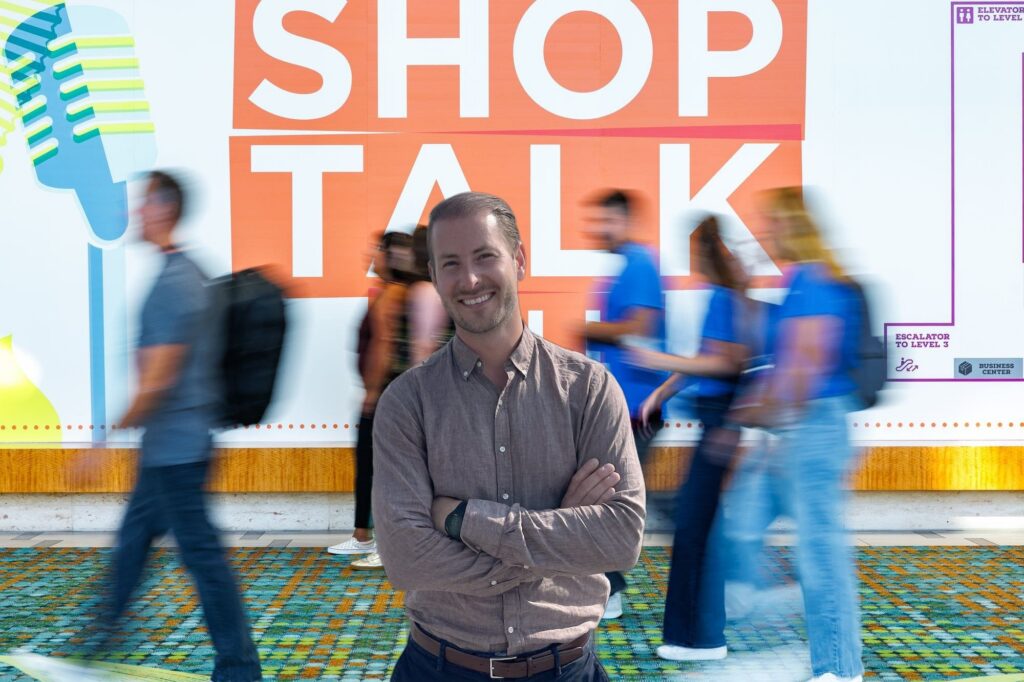
In summary, it was an insight-packed event offering firsthand perspective on the latest retail trends and technological developments. Nashville felt like the ideal host city for Shoptalk this year, with live music on every corner where people entertain people. So despite my conviction that agents will handle an ever-increasing share of actual purchasing, it was still the people who left the strongest impression: the founder livestreaming for 24 hours straight and the creator out-selling global superstars. Technology is getting smarter, but it's still those playing directly to the front row that win.
Nashville, September 29 – October 1, 2026 · Niclas Albäck, Ehandel.se