

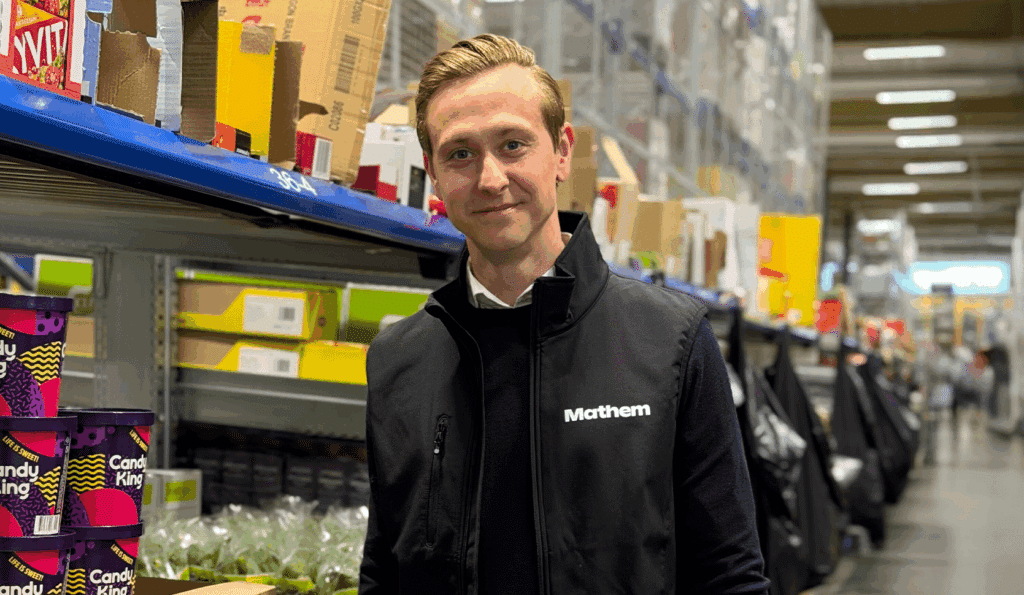
When Nikodemus Lindroos reflects on the recent recognition, he doesn't see it as a personal win, but rather as a confirmation of the journey the entire organization has made. Behind the numbers lies hard work to transform a business that has long struggled with profitability.
I think one feels very proud. We have had a turbulent time at Mathem for a long time and really taken enormous steps in the right direction. I think it's a receipt that we, as a team, have gotten through a tough time, but somewhere also shown that by challenging each other and lifting each other, we achieve these results, he says.
Reaching today's results, however, has required tough decisions. During 2025, the company was forced to notify a total of over 140 employees, partly as a direct consequence of the increased automation in Larsboda and partly to manage the finances. But when the Stockholm District Court approved the reconstruction plan last August, 700 jobs were saved, and the company was able to return to normal operations. It is against this background that Nikodemus Lindroos feels a particularly great pride in the staff today.
READ ALSO: 700 Jobs Saved - They Are Now Leaving Reconstruction: "Ready to Challenge"
So we have gone through a reconstruction in the past year and had a tremendously tough period, and we have had cuts that unfortunately have had to be part of it. But we still stand with an organization that is more driven than ever and enormously committed to driving us forward. You shouldn't take that for granted, and it's almost as if I myself am surprised at how well we managed to land.
The cultural shift that the staff in Larsboda has gone through also stands out when the operational manager looks back on his own professional life.
Nikodemus Lindroos has a broad background where he has moved between many different companies and industries, both in roles as a consultant and as a permanent employee. When he now compares Mathem's journey – from reconstruction and crisis to the strong teamwork that today characterizes the warehouse floor – with his previous assignments, it becomes clear to him that the development is rare. He describes the cultural shift that the organization has made in such a short time as something unique:
I have never heard of a turnaround like the one Mathem has been through. We do it through a turbulent time where employees and colleagues are more driven and happier than ever. It's not just that we've succeeded in performing, but we're also in a position where it doesn't end. We have a continued enormously committed business where I sometimes need to be the one pulling the handbrake.
The System That Sees the Problems
The difference between operations today and two years ago is described as night and day. A central part of the change is the implementation of Oda Systems, an automation and system solution that has changed the basic conditions for how food is handled. Instead of hiding bottlenecks in complex flows, the technology is based on bringing deviations to the surface directly.
This is our smarter system that allows us to ensure fantastic balance accuracy and a quality to customers that is incredibly good. We have good control over our flows and can work just in time. That was not possible in our previous solution, because it was based on having intermediate buffers between all parts of the warehouse. Now things go directly into the picking shelf so that the customer gets the absolute best date on their articles, says Nikodemus Lindroos.
The effect is clearly visible in the statistics on food waste. While many players in the industry are struggling with large amounts of discarded food, Mathem has managed to reduce the figures to levels previously considered unattainable.
We are at a shrinkage level of around 0.3 percent. I would have thought it very fun to hear what other colleagues in the industry are sitting with, because I think you almost hide when you hear how low it is. We hide no problems. We encourage everyone to lift them and then pause and solve them, so that it never goes wrong. There are never any customer impacts as a result of internal deviations.
Despite the fact that 0.3 percent food waste is a rarely low figure, the company is not satisfied with that. The goal ahead is clear, and the strategy to reach all the way involves thinking outside the warehouse walls.
I absolutely believe we can go lower. Our ambition is zero, clearly. One way to get there is through collaborations. Instead of us having to throw something away, we can have collaborations where they make ready meals from the food, or join forces with larger corporations that can buy from us a little earlier. Then we know, for example, in connection with seasons where we need to buy a lot of food before Easter or Christmas, if anyone is interested in a lot of Christmas ham after the holidays. Then we solve it in good time before we have any risk of spoilage at all.
Team Before Individual
Despite the high degree of automation, Nikodemus Lindroos emphasizes that people are still the most important component. A crucial strategic change has been to stop measuring individual performance and instead focus entirely on how the team delivers together.
If a person on the picking line is struggling, the system and culture are built to support instead of stress.
We never measure people as individuals, we only measure how a team delivers. How do we perform on quality metrics towards our customers and how do we deliver efficiency metrics together? If I were to go down to our picking line now and pick, I would get a lot of help. Partly because I'm not fast enough, but also because everyone on the line wants to make sure they can get as much out as possible.
This way of working requires leadership to be close to the business. In Larsboda, it is now rare to find managers at a desk.
We have built the organization from the driver or our employee in production first. What do they need? They need a team leader level that is with them. Then we make sure that 80 percent of their time is in the business. They should not sit at an office. It's a little cool when you see it. I think many who come here are impressed that we have an empty office among managers. You are out in the business, says Nikodemus Lindroos.
Efficiency Records on the Picking Line
The figures speak for themselves when it comes to the operational trimming. From previously being at a level of around 95 units per hour during manual picking, Mathem has now reached levels that challenge international records.
Nikodemus Lindroos reveals that the latest results are even better than previously communicated:
In fact, it's more than 120 percent efficiency now. We have been quite efficient when we picked manually before and were around 95 in what we call UPH. Today we are approaching 250 in UPH. These are enormous levels. It's fantastically fun and we do it even at lower volumes.
According to Nikodemus, the explanation for the increase is not that the staff is being pushed harder, but that the processes have become better through the employees' own feedback. By solving the small everyday problems, which he calls "shoehorns", a natural efficiency is created.
We do not drive efficiency by pushing employees or leaders hard. We do it by working together to come up with improvements that create a better working environment. We ask: Lisa and Kalle, what is your biggest shoehorn in everyday life? Let's solve it together. That builds pride when you have lifted something that can be better and been involved in making it happen.
The Road to Black Figures
Mathem's economic turnaround, from a loss of over 900 million kronor in 2024 to a profit for 2025 – albeit helped by debt write-offs – has required drastic measures.
Fixed costs have been cut by 60 percent, and operational inefficiency was a large part of the previous deficit. Among other things, the area for the business has been halved by going from two floors to one.
The footprint has been reduced by half and we have simultaneously increased our efficiency by more than double. The customer should not pay for us sitting on fixed costs. They should pay to get the best product delivered to their door with the best quality. We now also have a pricing strategy that makes us the lowest on the market when you calculate in the shipping.
The goal for the future is set. In 2027, Mathem will show the world that it is possible to achieve profitability in e-commerce for groceries, and Nikodemus Lindroos is confident that they will reach it earlier than planned.
The ambitions about when it happens are too low. I think we will reach it earlier than 2027. I feel the energy in our organization. It buzzes in the walls because things are happening all the time. We are absolutely not in goal, but we have all the prerequisites.
In conclusion, he sends a message to others in the industry who are facing major changes. For him, the key has been to dare to carry out the change fully and to let the responsibility rest on everyone, not just management.
Don't just talk about making a real change and a cultural journey. You have to do it and you should not put the weight on your own shoulders or the management team's shoulders. You have to put it on everyone's shoulders. It's not something you can push into an organization, it has to grow. I think we have dared to make the change for real, not just talk about it. No one is prouder than I am, concludes Nikodemus Lindroos.