

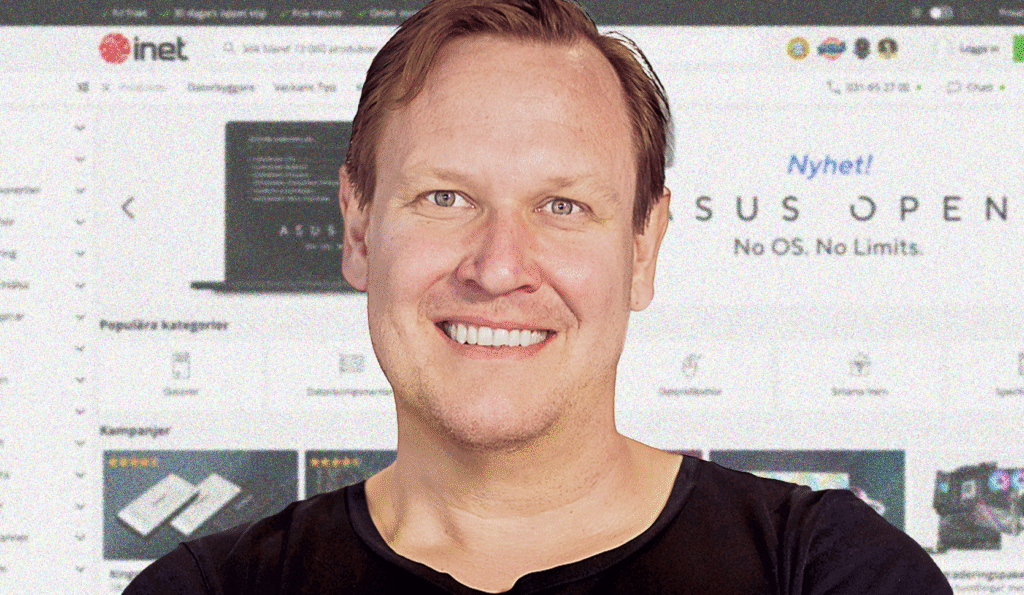
Last Thursday, computer and technology retailer Inet, together with the payment service Swish, announced that they had completed Sweden's first e-commerce purchase using an autonomous AI agent. The solution is based on the open standard Model Context Protocol (MCP), which allows external AI assistants to communicate directly with the e-commerce platform to search for products, build shopping carts, and initiate purchases.
Shortly after the launch, Ehandel.se chose to conduct its own live test of Inet's MCP connection to see how the technology works in practice. Now, Inet's CEO Erik Wickman is summarizing the first few days with the new sales channel.
We have received just over 20 customer orders via our MCP so far. They are all live orders, but it is clear that they are test orders, like the one you at Ehandel.se placed. It works well and has been very well received, says Erik Wickman, CEO of Inet, to Ehandel.se.
Security and Technical Limitations in Focus
When Ehandel.se tested the service, a number of technical limitations were identified in how the purchase flow is set up. Among other things, the system forced the delivery address and phone number already registered on the customer account, which meant that the AI agent could not redirect the delivery to another recipient or number. According to Erik Wickman, this is an intentional lock during the launch phase.
It is a conscious choice to minimize risks in the beginning. We chose to keep the scope as tight as possible in the first stage, but we will look at solutions for other delivery addresses if the volume increases, says Erik Wickman.
During Ehandel.se's test, it also became clear that authentication against the customer account required logging in locally on the user's own computer, via so-called localhost, which made logging in difficult for AI agents running in the cloud or on a separate virtual machine. Inet is also open to adjustments later when the technology has been evaluated.
That could definitely be relevant in the future. In this first phase, we want to evaluate the test, collect feedback and analyze the data we receive, says Erik Wickman.
Another detail that was noticed on the order confirmation after Ehandel.se's test purchase of a can of compressed air was that the product was marked as excluded from the right of withdrawal.
The reason it said that is because the product is a consumable. It has nothing to do with the AI purchase itself, clarifies Erik Wickman.
Protection Against Purchase Bots and the Future of Payment Flow
Opening up structured interfaces for machine trading also raises questions about so-called scalping, where automated purchase bots sweep the stock of sought-after hardware components during major product launches. This is a challenge that the industry already handles daily.
Scalping is partially a problem for us and the bots are constantly getting better at bypassing our protections. I cannot reveal exactly how we stop them, but an example is that we have a rate limit that limits the number of calls over a certain period of time, says Erik Wickman.
In the current implementation, the AI agent cannot complete the entire transaction on its own, but the customer must manually approve the purchase in the Swish app with BankID. Whether e-commerce is moving towards fully autonomous purchases without manual intervention at the time of payment remains to be seen, but Inet does not rule out such a scenario in the long run.
Currently, we believe in retaining at least one manual step. But we see that in the future, depending on the payment method, we may be able to scrap that requirement. It is still very early days and we are closely following developments to continue to be at the forefront, says Erik Wickman.
Component Shortage, Inventory Strategy and Black Week
In addition to the technical investments in agent trading, the home electronics and computer industry is in a challenging market situation. During the year, soaring prices and a global shortage of memory chips and storage components, driven by the large-scale expansion of AI data centers, have put pressure on manufacturers and retailers. At Inet, this is noticeable through lower volumes, but an early purchasing strategy is maintaining profitability.
The market is extremely tough and unpredictable. We sell significantly fewer units, but are saved by the fact that we have long ago bet that prices would rise and therefore had a lot of goods in stock at a good purchase cost during the year. As a result, it will be a good year in terms of results, even if we lose turnover, says Erik Wickman.
In the longer term, the company expects continued subdued demand from private individuals, which means that corporate sales will play an increasingly important role.
The future is incredibly difficult to predict, but I believe in a weak 2027 for consumer retail. However, our investment in AI hardware for companies is intended to compensate for the lost consumer turnover, says Erik Wickman.
In the short term, however, there are glimmers of light in the consumer sector. On Friday, November 13th, Inet launched its Black Week campaign, and the sales start over the weekend has exceeded the company's forecasts after a hesitant autumn.
Black Week has started better than expected. There seems to be a greater pent-up purchasing need than before after a vacuum in October and early November. We have also steered much of the campaigns towards, among other things, really well-priced screens that are not affected by the memory shortage, concludes Erik Wickman.