

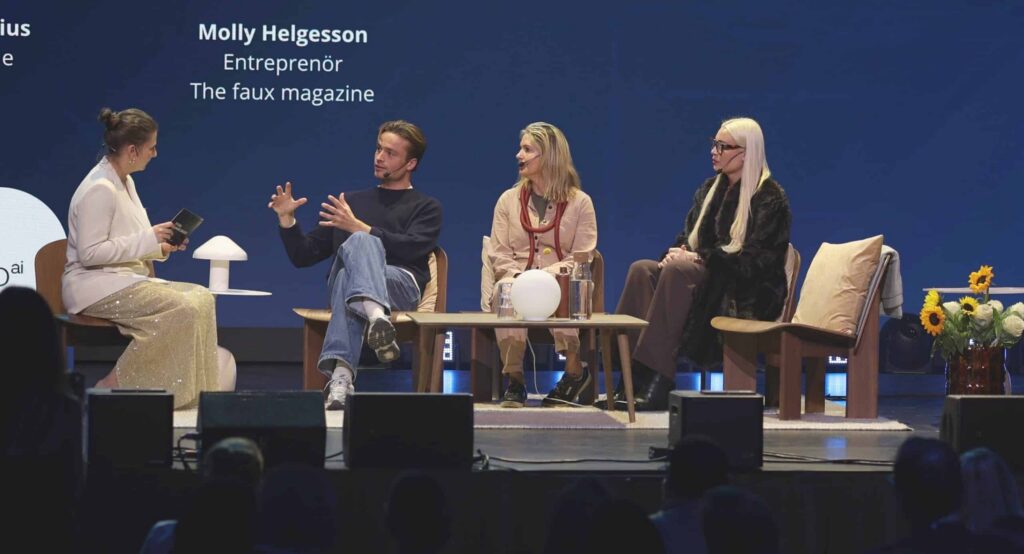
Many brands are today touting the concept of community, but in practice, it often comes down to a traditional customer club or a simple email list. When Ehandel.se's editor Izabella Borowska gathered multientrepreneur and By Benson's chairman Pingis Berg-Hadenius, Pändy's global marketing manager Nils Lindgren, and Molly Helgesson, CEO and founder of Reworked Treasures, on stage, the message was clear: a newsletter or a discount code has nothing to do with a genuine community.
According to Pingis Berg-Hadenius, the sharp dividing line lies in the brand's ability to create genuine involvement and interaction between customers.
It's more about building a relationship to begin with, and that you want to be part of this community for something more than just getting a discount code or an offer, that you want to be involved in the brand, says Pingis Berg-Hadenius, adding that the goal is to get members to have a dialogue with each other rather than just leaving fleeting comments in a feed.
Nils Lindgren at the confectionery and dietary supplement company Pändy believes that traditional customer clubs have an inherent vulnerability because loyalty is bought with price reductions.
If we compare it to a customer club that may be more offers, loyalty programs and discounts. If you remove that part or reduce that part, then I think many in that customer club will jump to another club because they have better offers there. But if you build a community based on relationships, then they will stay regardless, states Nils Lindgren.
Significantly Lowers Customer Acquisition Cost
For e-commerce companies pressured by ever-increasing click prices from tech giants, an engaged community is not just a soft branding issue, but hard currency on the bottom line. Pändy is currently present in around 30 markets and actively works to cultivate long-term relationships with both end consumers and smaller and larger creators.
By inviting market activations and events with the sole purpose of building personal relationships, the company has created a culture where ambassadors independently drive sales.
They want to promote Pändy, they want to spread the word about us and they want to promote a new product when we have launched it because we have built these relationships with them for so long. And we don't need to spend much money on it. If we talk e-commerce terms, it significantly lowers our acquisition cost and contributes to both a profitable and strong business, says Nils Lindgren.
For Molly Helgesson and her rapidly growing brand Reworked Treasures, the commercial leverage is about educating members in clear purchasing patterns and rewarding them with priority access rather than price reductions. Jewelry releases always take place on the same day and at the same time every Sunday, creating a learned habit and expectation.
I don't think discounts are the best there, but that they get exclusivity or quick access before someone who is not in the community, I think drives better sales at least for us, explains Molly Helgesson.
The Customer as CEO and a Living Focus Group
A common thread throughout the conversation is how the companies use their communities as a direct-acting test lab. Instead of guessing which assortment will sell, or ordering expensive market research, the panelists let members help steer everything from pricing and color choices to flavors and design.
At Pändy, both consumers and creators are involved early in taste tests during product development. At Reworked Treasures, followers get to vote on design choices for furs and jewelry, making customers feel like co-creators of the brand.
It's a very fine line between designing or producing what you want to do yourself and knowing that the customer is your boss. If there is no demand for what you yourself think is good and should sell, then it is important to listen the other way and say: okay, but there were 200 people who wanted this product, then we will do that instead, says Molly Helgesson.
Pingis Berg-Hadenius compares the working method to a constant, living focus group where the brand can tease new models to build hype before launch. In the case of By Benson, which sells products for home and garden, it is also about giving back in the form of knowledge about cultivation and resilience. To increase the value further, By Benson now plans to build out a more closed, inner room for its most engaged customers.
According to Pingis Berg-Hadenius, a smaller barrier to entry can be an effective tool to raise the status and engagement of the group, as people appreciate contexts where they feel selected.
When the Drive Starts in Your Own Channels
Letting customers close to the business and letting them discuss freely in open forums also involves a risk. On a public question about how to move from a passive customer club to an active community – and what to do when members suddenly turn against the company – the panel agreed that openness is the only working defense.
Pingis Berg-Hadenius emphasizes that a basic structure with clear rules and sometimes login requirements is required to maintain a good hygiene level in large groups, but when criticism does come, it is important to never bury your head in the sand.
You can always meet adversity with success if you address it and show that you clearly respect the criticism you receive. Then you can get your community with you and turn this around, she says.
Molly Helgesson adds that the personal tone is crucial for how forgiving customers are when something goes wrong, even in a time when many are automating their customer service.
Even if you may have AI answering emails, you can work to create a good AI that feels very personal. I think many just throw in AI and answer so and so, but trying to go back to basics and make it personal all the time means that there is also much more forgiveness, she says.
For e-commerce companies that want to start building their own community tomorrow, the panel concludes with three concrete takeaways: define a clear purpose of what the brand stands for and against, dare to seek external help if the internal strategy is missing, and change the view of what customers can actually contribute with.
We see our community as an extension of our marketing team which is a small, small team. See them as an extension, see them as doing a lot of work for you and just start from there, concludes Nils Lindgren.