

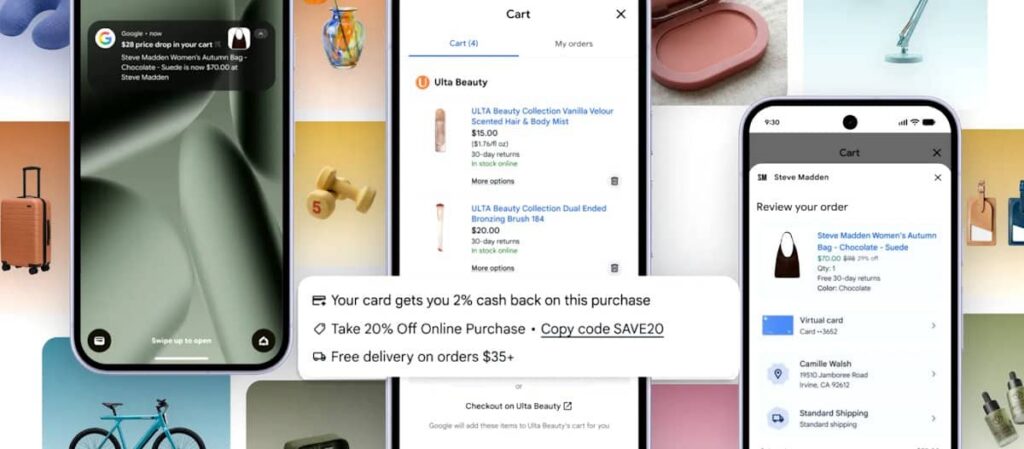
On Thursday, Google officially launched its new Universal Cart feature in the US market. The service is now available directly in Google Search, including the search function's AI mode, as well as in the Gemini app.
The launch is the next step in the investment in agent-driven e-commerce that Ehandel.se reported on in the spring, when the tech giant first previewed how AI agents can complete purchases for consumers. The new shopping cart is built on the open standard Universal Commerce Protocol (UCP) along with Google's Shopping Graph, which includes over 60 billion continuously updated product listings.
Collects competing retailers in one checkout
The purpose of Universal Cart is to eliminate the need to keep dozens of browser tabs open or save screenshots when consumers compare goods. Instead, the user can add products from a wide variety of retailers – including Nike, Sephora, Target, Ulta Beauty, Walmart, Wayfair and connected Shopify merchants – to a common shopping cart.
In the background, the system automatically monitors both stock status and price changes for the saved products and sends notifications when prices drop. According to Suresh Ganapathy, Product Manager for Consumer Shopping at Google, the company's e-commerce strategy rests on two pillars: autonomous agent capabilities that act on behalf of the user in the background, and practical tools that give consumers an overview and control before making a purchase.
Optimization via Google Wallet
When the consumer chooses to proceed to checkout, the shopping cart is integrated with Google Wallet. The AI system then automatically searches for valid discount codes and analyzes which credit card in the wallet provides the best benefits or bonus points for the specific purchase.
The transaction can then be completed directly in the universal shopping cart with a couple of clicks via Google Pay, or transferred to the retailer's own checkout. Regardless of which path the customer chooses, the e-retailer always remains the formal seller of record and is responsible for order confirmation, delivery and customer service.
Maps when Christmas discounts peak
In parallel with the rollout of the universal shopping cart, Google is also presenting the report and buying guide When to Buy Guide in preparation for the upcoming Christmas shopping season. The mapping is based on historical search and discount data from US retailers on the platform and shows that the lowest price level rarely occurs simultaneously for all product categories.
For perfumes and fragrances, discounts reach their highest level early in the season, with the most advantageous purchases made within two weeks after Black Friday. If consumers wait longer than that, the supply tends to run out while price reductions level off. For handbags, the opposite pattern applies. Google's data shows that it pays to wait past Black Friday until mid or late December to get the best price and selection. Also, the biggest price drops for tech toys don't appear until the very last weeks of the year.