

For many years, building e-commerce businesses was about raising as much venture capital as possible to finance aggressive growth. But when the market turned, the dream of rapid expansion became a nightmare for many entrepreneurs who suddenly found themselves stuck in complicated ownership structures with spiraling costs.
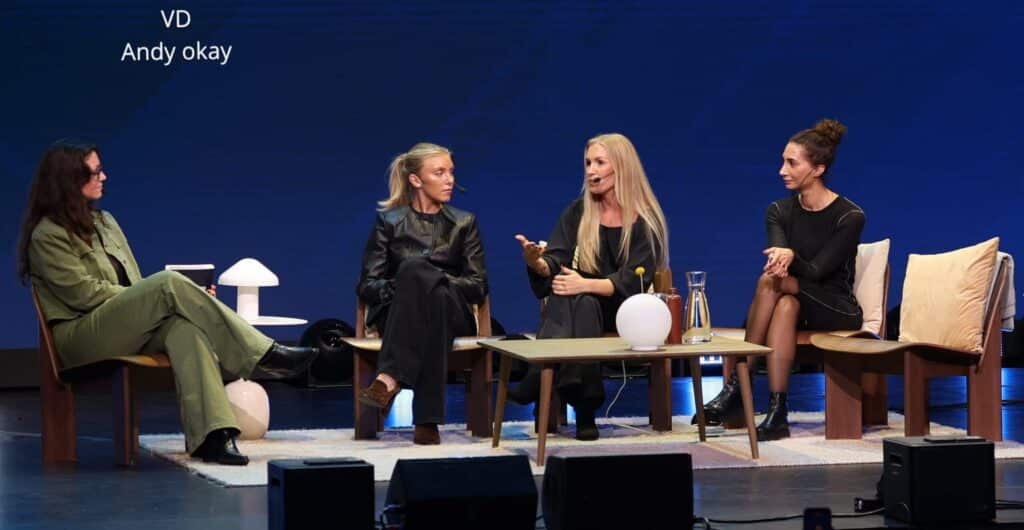
When e-commerce profiles Sanne Josefsson from Sanne Alexandra, Amanda McKee from Kiano, and Naslin Ossanloo from Andy okay met in a panel discussion moderated by Sara Sorbet from Feminvest, the power balance in the boardroom was central to the conversation. All three have, in different ways, navigated ownership changes where control of their own businesses was at stake.
Bound Hand and Foot in Her Own Name
For Sanne Josefsson, who founded the fashion brand Sanne Alexandra, the situation as a minority owner eventually became unsustainable. Although the previous co-owners had been an important part of scaling up the business, she found herself in a position where she could no longer steer the company that bore her own name.
Since the customer base largely consisted of her own followers on Instagram, it was hard to have to market products and pursue a financial line she didn't believe in. In the fall of 2023, she decided to hire a lawyer and initiate an eighteen-month process to buy back control.
I can say that I slept better at night when I fought to buy out the majority, or regain the majority, because it felt right to me. When I was bound hand and foot, well, I felt terribly bad, says Sanne Josefsson during the discussion.
Once the deal was finalized, she faced a company in urgent need of restructuring. Sanne Josefsson was forced to personally travel around to suppliers to sign new agreements, ask them to release products despite old debts, and promise to repay them. This was followed by a relentless cost-cutting drive to prove that the business could be self-sufficient.
We photographed everything with our mobile phones, i.e., cut all costs. We didn't have a single Meta ad running last year until around November 20th. It was just organic sales. I cut every cost, says Sanne Josefsson.
By relying on the direct relationship with her customers, she quickly turned the ship around to profitability. When the company resumed paid advertising via Meta at the end of last year, the response was immediate. Today, 70 percent of sales come from new customers, and the company has just hired a dedicated buyer to ensure that the basic range does not run out of stock during continued scaling.
Cut Everything and Increased Business Tenfold
Amanda McKee has had a similar journey with the supplement and health company Kiano. She had previously founded a company where she ended up in the minority and experienced what it was like to be a CEO expected to deliver growth without having the mandate to make crucial decisions. She then chose to sell her shares in that company and instead buy out Kiano from the same investor group to become the sole owner.
It's better to keep the cap table very simple. I've seen many great companies go under precisely because of a fragmented cap table or ownership disputes. In the beginning, you need to be able to make quick decisions and just go for it, not sit around with a lot of different opinions and spend so much time on stakeholder management, says Amanda McKee.
When she took over Kiano, she saw a well-managed company with good products, but with a scattered strategy built to become a billion-dollar company overnight. The company advertised in English in ten different countries simultaneously in a variety of channels, sold via Amazon, physical stores and resellers, and generated revenue through constant discount campaigns.
Since Amanda McKee chose to run the company forward without new venture capital, profitability was required from day one. She therefore decided to scrap the international expansion, cut all external resellers to own the customer data and margin herself, raise prices and stop the monthly sales.
Sometimes it's easy to think that if we need to grow, we need to do more things, but you often just need to do one thing really well. So the only thing we did when I bought the company: Meta ads in Sweden. And we generate more than ten times as much revenue as when I bought the company just with that, says Amanda McKee.
To avoid losing the old customers who were used to constant discounts, she instead introduced profitable multi-packs for loyal customers, combined with a few targeted mailings per year to the most price-sensitive customers. Only now, when the Swedish business is properly scaled and profitable, has Kiano begun to connect Denmark, which today accounts for about ten percent of turnover.
Sold the Majority on Her Own Terms
While Sanne Josefsson and Amanda McKee bought back their companies to gain peace of mind, Naslin Ossanloo at the art and e-commerce company Andy okay has recently done the opposite. Together with her partner and co-founder Andreas, she has built up the business entirely without external capital, among other things by keeping expenses down and letting the company grow organically.
One of our biggest goals was that we always wanted to be profitable. I mean, we didn't want to raise investment at an early stage to build the company, but rather that the company should be able to support itself, says Naslin Ossanloo.
With good profitability, strong cash flow and international sales from the start, there was no financial pressure to bring in shareholders. But when the company reached its set revenue targets, the founders began looking for the right expertise to take the next step. After a year of dialogue with e-commerce profile Jarno Vanhatapio, the contacts led to listed Vetted Assets, formerly Refine Group, which recently acquired 51 percent of Andy okay.
Despite an initial skepticism about giving up the majority, the founders were convinced that the buyers themselves consisted of experienced entrepreneurs behind companies such as Nelly, Stronger and NA-KD. To avoid falling into the same trap as many other founders, Naslin Ossanloo and her partner made sure to become major shareholders in the parent group itself, while also negotiating clear protective mechanisms in the agreement.
We didn't sell 70 percent but 51 percent, and we still have voting rights on certain decisions that can be made in the company. And it was important for us to have that in place, explains Naslin Ossanloo.
The Warning to Other E-commerce Companies
When the panel looks back on their respective journeys, the message to other entrepreneurs is clear. It's about daring to trust your own gut feeling, understanding exactly why you're letting in an external party, and never seeing venture capital as a lifeline for a broken business model.
Stop chasing money, chase revenue and profitable growth, then the investors will come to you instead, says Amanda McKee and concludes:
Raising capital is often a short-term solution to a long-term problem if you're not profitable.