

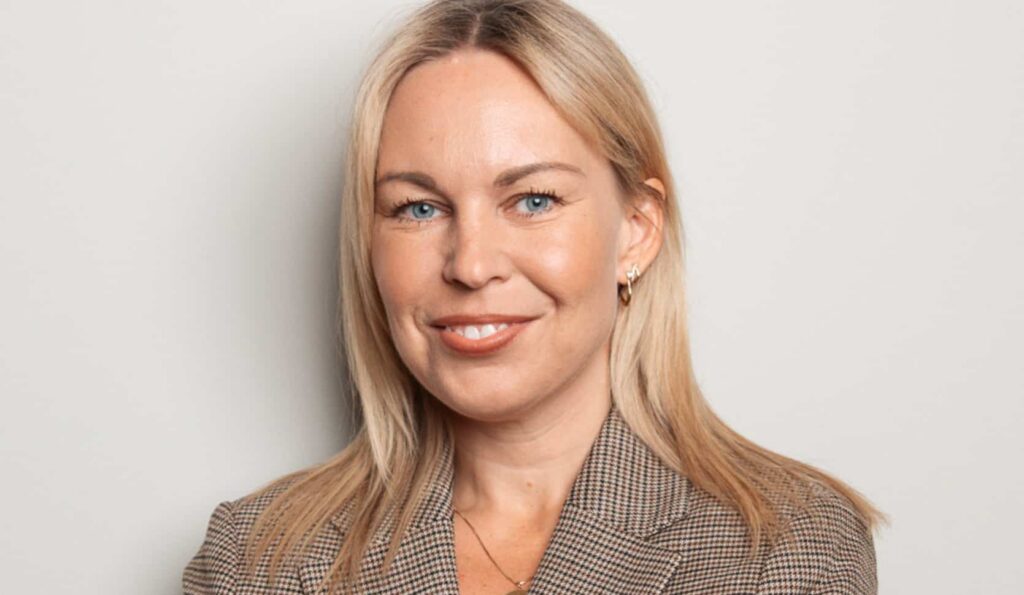
Instead of launching a single solution for the entire international market, the interior design chain has chosen a more divided strategy. The initial focus is on specific countries where they see their assortment fitting well, combined with a broader portal for other markets.
In the first phase, we have chosen to establish locally adapted websites for Norway, Finland, Denmark and Germany, complemented by an EU site to reach customers in more European markets,” says Johanna Ohlsson.
The decision on which countries received their own local websites was based on distance and culture. At the same time, the company wants to tackle one of Europe's largest economies from the start.
The selection was made based on several factors. The Nordic markets are close to us geographically and culturally, which makes them natural to start with. At the same time, we see great opportunities in Germany, which is a much larger e-commerce market and therefore also very interesting from a long-term perspective.
According to Johanna Ohlsson, there is a clear advantage to the niche the company has.
We also see that Scandinavian design has a strong appeal internationally, which gives us good conditions to take our offer further outside of Sweden. It therefore feels natural to test the potential in markets where interest in Nordic design is high.
The overarching international website functions as a bridge to identify new opportunities outside the focus countries.
The EU site is a way for us not to limit expansion to individual countries, but to create a platform that makes it possible to gradually test and grow in more European markets,” says Johanna Ohlsson and continues:
It’s also a lot about learning. By establishing ourselves in markets with different conditions, we can understand where our offer has the greatest potential and then prioritize investments accordingly. We see this expansion as a long-term investment, where the first markets now also become important for building experience for the next step in Europe.
Logistics controlled from Sweden
Shipping goods abroad places high demands on warehousing and deliveries. The company has chosen not to spread its goods in different European facilities, but to build on the system they already use at home.
Logistics has been an important part of the expansion and something we have built to be able to scale internationally. We have basically been able to base it on our existing warehouse and logistics structure in Sweden, but adapted the processes to handle more markets, currencies, shipping options and delivery flows,” says Johanna Ohlsson.
To ensure everything runs smoothly in the background, all sales data is entered into the same digital flow, regardless of which country the customer shops from.
Orders from our international websites are handled in the same overall system as our Swedish orders, which means we can keep together warehousing, order management and customer service efficiently. Our tech team has done a fantastic job getting all the parts in place and creating a technical solution that allows us to grow internationally without having to build completely separate structures for each market.
The choice to keep the goods at home is about keeping costs down during the start-up phase.
We have chosen not to build separate warehouses in the first stage. It gives us a more flexible and cost-effective model while we are still building volume in the different markets,” says Johanna Ohlsson.
However, she points out that the strategy may change in the future.
At the same time, we are of course closely monitoring developments, as volumes grow, it may be relevant to supplement with other logistics solutions.
Another aspect of the international launch is the customer experience after the order has been placed.
An important part has also been to get the entire customer journey to work as smoothly internationally as at home. This means not only that the package must arrive, but also that, for example, delivery options, returns, payments and information to the customer work in each market.
It is precisely the interaction between systems, warehouses and other parts of the organization that has enabled us to carry out this expansion in such a good and cost-effective way.
No specific turnover targets at the moment
Regarding how large a share of sales should come from Europe in the future, Designtorget chooses not to commit to any specific figures. They see the investment as a long-term project.
We have high ambitions with Europe, but we do not want to lock ourselves into a specific turnover figure so early in the expansion. We have built up the business in the Swedish market for 30 years, and now we are at the beginning of a completely new growth phase internationally,” says Johanna Ohlsson.
Our ambition is for Europe to become a large part of our total e-commerce within three years, but we want to focus primarily on building a long-term profitable business rather than chasing a certain percentage of turnover.
The primary focus right now is to understand which strategies work best in which countries and then ramp up volumes.
What is important to us now is to find the right footing in the markets we have chosen, understand what works locally and then scale it. We have a strong position and long experience in Sweden, and that experience gives us a good foundation to build on internationally. At the same time, we are humble to the fact that every new market requires time and adaptation.
Although e-commerce has just been rolled out, orders have already begun to come in.
We have already started selling in all the markets we have opened up. It is very positive to see that customers are finding us and choosing to shop, even though we are still early in the establishment,” she says.
Three of the selected countries are showing the best results in this early phase.
So far, it is mainly Norway, Finland and Germany that stand out sales-wise. These are also markets that we anticipated were particularly interesting and are focus markets, so the development is very much in line with our expectations.
At the same time, it is too early to draw any far-reaching conclusions about which market will be the largest in the long run. We have only just begun to build a presence internationally and the focus now is to understand what works in each market, optimize the customer journey and gradually increase awareness of us. What feels most positive is actually that we see demand in all markets right from the start. That gives us a good foundation to build on.
Physical and digital commerce side by side
Shortly after the online stores opened to the foreign public, the company inaugurated its new physical store in Uppsala. For the company, there is no contradiction between growing online and offline.
The physical store is still an important part of our strategy, and we recently opened our new store in Uppsala. We still see great value in the personal meeting with the customer and being able to offer a physical experience that complements our e-commerce,” says Johanna Ohlsson.
More physical stores may become relevant, but growth will happen at a calm pace.
We also have plans for more physical stores in the future. Exactly where and when we establish the next store depends on the opportunities we see and how we assess the potential in each location. We want to grow long-term and ensure that each establishment is good, rather than opening a large number of stores in a short time.
The synergy between the two channels is central to how the company views the future.
At the same time, we see our physical stores and the digital expansion as two parts of the same strategy. The stores strengthen our brand and customer relationship, while e-commerce allows us to reach much wider geographically.
The question of physical stores abroad is kept open, but is not currently relevant.
When it comes to physical stores abroad, it is absolutely something we can consider in the long run. But right now, the focus is on establishing and developing our digital presence in the new markets. When we have gained more knowledge about where the demand and potential are greatest, we will decide whether a physical presence is the next natural step.
The downturn does not stop the plans
Despite a tough economic climate for retail, the company chooses to invest double. Experience from the Swedish market makes them dare to look ahead.
The economic climate is of course something we take into account, but it has not changed our long-term ambition to grow. We have been on the Swedish market for over 30 years and have a long-term perspective on our business,” says Johanna Ohlsson.
She believes that the new initiatives are necessary for the company's continued journey.
For us, the expansion is therefore more about building the next phase in the company's development than about reacting to the short-term economic climate.
To minimize risks, high demands are placed on every investment.
At the same time, a more challenging economic climate means that we are extra careful in our investments and want to see that every investment has a clear potential. The digital expansion gives us the opportunity to test and establish ourselves in new markets in a relatively flexible way, while the physical stores are more long-term investments.
Johanna Ohlsson summarizes the situation by saying that breadth gives them security:
It is also a strength that we can combine the two. We do not have to choose between physical and digital growth, but can develop both in parallel and let the experiences from one part strengthen the other.
So even if the economic situation affects how we prioritize and invest, it has not made us slow down on our growth ambitions. Rather, it has made us even more focused on growing in a healthy and long-term way.