

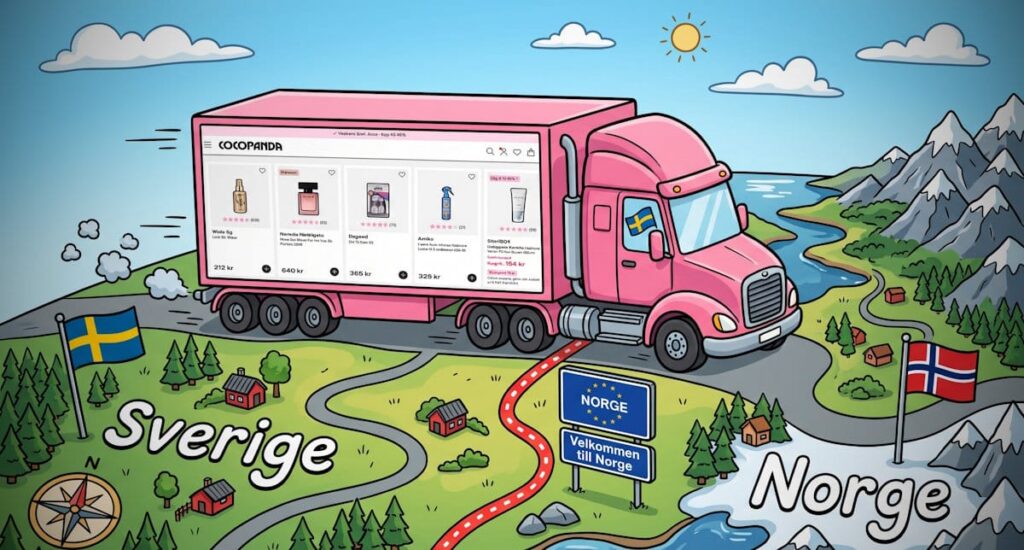
The online store Cocopanda, which sells hair and beauty products on the Swedish market with goods supplied from the group's central warehouse in German Flensburg, has operated through the Swedish company Cocopanda Sweden AB since its launch in 2014. Now, it has been confirmed that the Swedish corporate structure will be phased out after twelve years.
According to the recently submitted annual report for the financial year 2025, the board of directors has decided to close down operations in the Swedish company as part of a group restructuring. The Norwegian parent company Brandsdal Group AS, based in Kristiansand and founded by Einar Øgrey Brandsdal with Kolbjørn Ertzeid as CEO, will instead consolidate operations in its home country.
Deviates from the Going Concern Principle
The decision means that the annual report for 2025 has not been prepared using the assumption of going concern, the so-called continuity principle. In 2026, a process has been initiated for a voluntary rapid wind-down and liquidation of Cocopanda Sweden AB.
Concurrently, a tax-free conversion of the branch Cocopanda Sweden NUF into a Norwegian limited company is being carried out. The Swedish operations are thus moving entirely to Norway, and no future business operations will be conducted in the Swedish company. Previously, Ehandel.se reported on how revenues decreased in Sweden while the beauty giant tried to achieve profitability and how the tax domicile was then moved to Norway.
Lost 100 Million Since Peak
The phasing out of the Swedish corporate structure is taking place after several years of declining sales volumes. During the financial year 2025, net sales in Cocopanda Sweden AB amounted to 184 million Swedish krona, a decrease of 17.5 percent, or just over 39 million krona, compared to 223.2 million krona in 2024. Compared to the peak year of 2021, when sales were 282.7 million krona, sales in the Swedish company have decreased by almost 100 million krona.
In the management report, management states that 2025 has been a year of negative growth, which is largely attributed to an increased focus on profitability, a changed product mix and changing consumer purchasing patterns.
Despite a focus on cost control, operating profit deteriorated in 2025 to -5.7 million krona, compared to -3.7 million krona the previous year. Profit after financial items amounted to -3.95 million krona, which was in line with last year's -4.03 million krona. After receiving a group contribution of 3.47 million krona, the profit for the year was written down to -477,000 krona, compared to a profit of 1.7 million krona in 2024 when the parent company contributed 5.75 million krona in group contributions.