

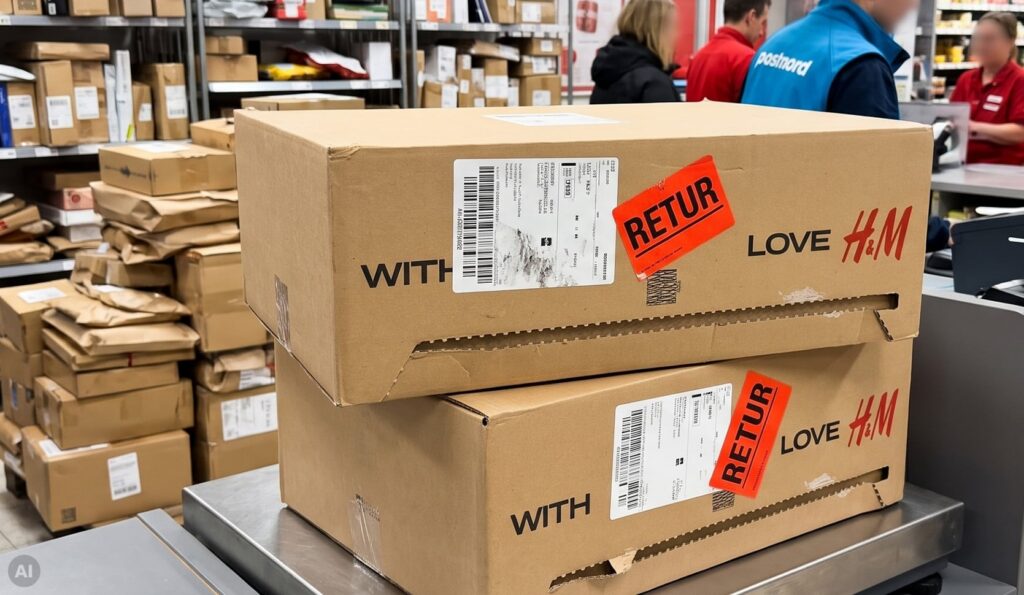
When returning an order with the wrong size or fit after a promotional purchase from H&M, the conditions in the official return policy are clear. A return registered online and submitted via a post office costs 39.99 Swedish krona, or just under 40 krona per shipment.
The fee is automatically deducted from the amount refunded to the customer, while returns to a physical H&M store or via Budbee boxes at select stores are free of charge. If the order also contains items from external brands, the return fee is charged separately per brand.
During intensive trading periods such as Black Week, it is also common for the same household to place more than one order over a few days, for example when new promotional offers are released in stages or when an item is temporarily out of stock and replenished in a new order.
To investigate how the fashion giant’s return flow handles combined returns, Ehandel.se conducted a test with H&M’s customer service today. The question concerned whether it is possible to pack return items from two different orders in the same physical bag or box to save space and avoid double transport. The answer was a clear no.
In order for the return to be registered and processed correctly, the items from each order must be sent back in separate packages with accompanying return shipping labels for each order, H&M’s customer service replies.
Double Shipments in Peak Season
The consequence of the rule is twofold.
Firstly, a fee of just under 40 krona is charged per order, which means just under 80 krona in return fees for two separate Black Week purchases shipped back via the post office. Secondly, two physical packages are forced into the logistics network from the same sender to the same receiving warehouse.
From an industry perspective, the requirement for separate shipments comes at a time when the logistics chain is already being pushed to its limits. Right in the middle of Black Week and the upcoming Christmas rush, package volumes are peaking at both post offices and parcel lockers, creating bottlenecks and congestion in the delivery link.
As Ehandel.se recently reported, industry experts point out that the changing volumes ahead of Christmas place demands on developing processes throughout the entire supply chain.
In recent years, a large part of the e-commerce industry has also put significant effort into reducing the amount of unnecessary air in packages and cutting the number of transports. Several e-retailers and return platforms have therefore built technical flows where multiple order numbers can be linked to the same return label, so that goods from different purchases can share a common package.
Automation Sets the Framework in the Warehouse
The fact that large fashion players like H&M still adhere to the rule of one package per order has a fundamental technical and operational explanation. In highly automated central warehouses and return systems, each unique shipping label and package ID is directly linked to a specific order number in the business system.
When a return package is scanned upon arrival, the barcode on the shipping label triggers an automated check against exactly the items belonging to that particular order. If items from another order are in the same package without the system supporting co-registration, the automatic flow is broken. The result is that the shipment must be picked out for manual troubleshooting, which drives personnel costs in the warehouse and risks delaying the refund.
The technical choice thus illustrates a classic trade-off in modern e-commerce logistics: a strict one-to-one connection between order and package provides fast and error-free machine sorting inside the warehouse, but instead moves more packaging, extra package volumes and double fees in the transport link.
Ehandel.se has contacted H&M’s press department to give the company the opportunity to explain why combined returns are not technically possible in the flow today and whether the fashion chain has any plans to develop the return system in the future.