

The development within e-commerce is now rapidly moving from AI-based chatbots and product recommendations towards so-called agentic commerce, or agentic commerce. On Thursday, electronics retailer Inet and payment service Swish announced that they have successfully completed Sweden's first purchase where an AI agent handled the entire order flow independently.
In this case, the customer tasked the AI agent Claude with finding a suitable USB-C cable at Inet. The agent located the product, selected delivery options, and then initiated the payment. The customer's only active contribution was to approve the order in the chat and sign the purchase in the Swish app. After completing the signing, the AI agent independently verified with Inet's system that the order was paid and confirmed.
Shopping Without Visiting the Website
What distinguishes an agentic purchase from traditional e-commerce is how communication between the consumer interface and the retailer's platform takes place. The purchase at Inet was carried out via the company's connection to the open standard Model Context Protocol, abbreviated MCP.
Through the MCP connection, the AI agent can communicate directly machine-to-machine with Inet's internal systems and call the store's API functions directly. This means that the AI agent never needs to open a web browser, download graphical elements, or navigate through a traditional interface on Inet.se to add items to a shopping cart and proceed to checkout.
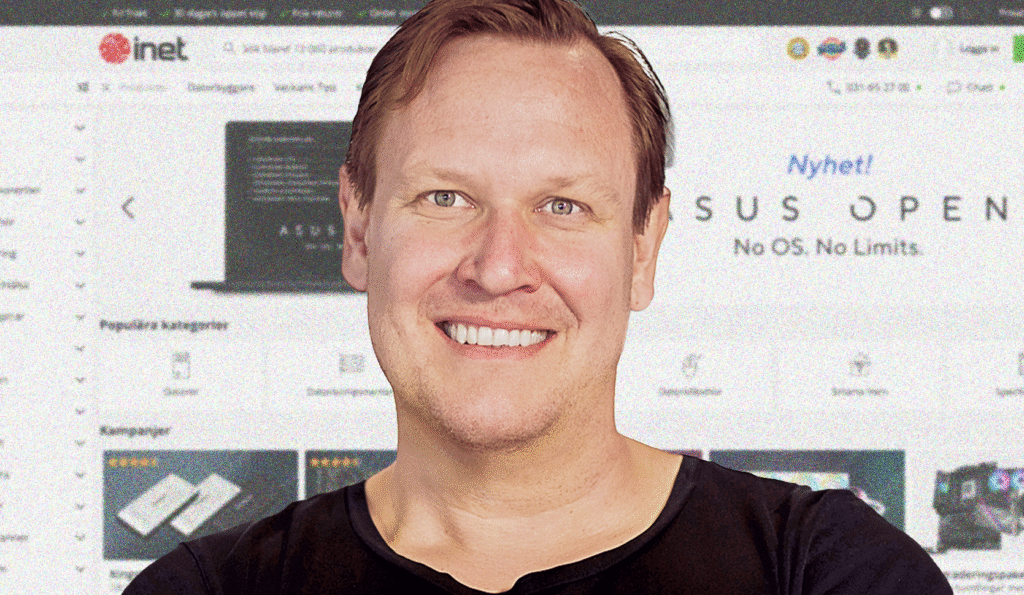
For us at Inet, "first with the latest" is about more than just new technology. It's about daring to explore how it can make a difference for our customers. With Sweden's first agentic customer journey, from need to purchase, we are showing a possible direction for the future of commerce. But ultimately, it is the customers who decide what is worth building on, says Erik Wickman, CEO of Inet, in a comment on the project.
A Growing European Trend
The shift towards machine-driven commerce is now broadly underway within the European e-commerce sector. Ehandel.se recently reported on how Zalando's B2B business is making major investments in AI agents that shop for customers – however, this involves an internal AI assistant in the fashion giant's own app, unlike the solution from Inet and Swish where a completely external and independent agent connects from outside to the retailer's systems.
Analysis firms and payment players also point to a rapid shift in consumer behavior. According to a recent report from Mastercard, one in ten consumers are expected to regularly use autonomous AI agents to make their purchases and payments as early as 2030.
Securing Position in New Channels
For payment services, the shift means that transactions are moving out of retailers' own checkout pages to external AI interfaces. Swish has recently been actively working to broaden its ecosystem, with Ehandel.se reporting, among other things, when Swish took the step globally to tens of millions of merchants through international collaborations. With the pilot test with Inet, the company is now taking the next step to secure its position as a payment standard even when autonomous agents take over the purchasing process itself.
It's a hugely exciting development that we want to be a part of shaping. The purchase at Inet is a first example of how Swish can function in this new type of customer journey. In agentic commerce, where AI manages more and more areas, it becomes essential to offer payment methods that people trust and recognize, says Urban Höglund, CEO of Swish.