

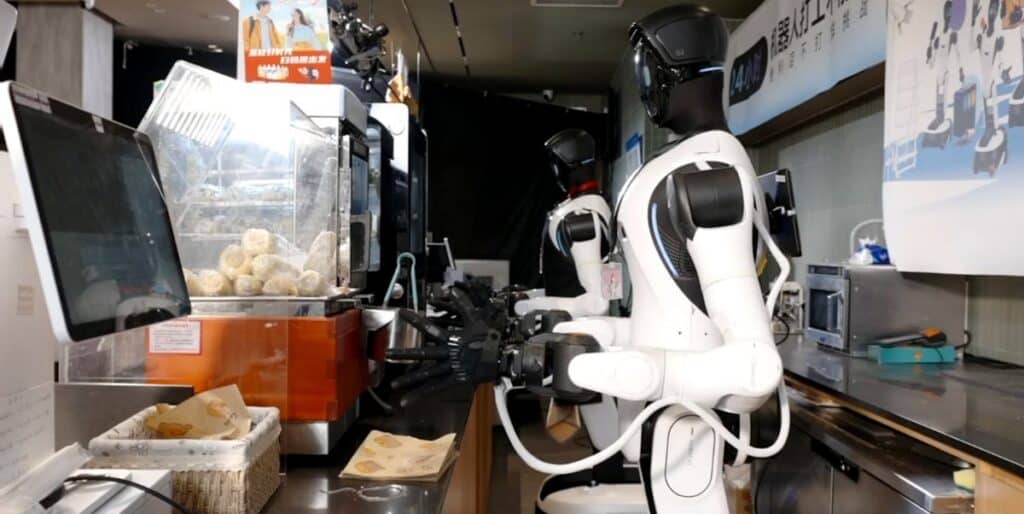
Between November 2nd and 3rd, the Chinese technology company Agibot conducted a 24-hour field test in the Xuhui district of Shanghai. Under the name "Robots Never Clock Out," six humanoid robots of the G2 model, equipped with a wheeled base, were placed in a typical convenience store to manage ongoing operations in a live environment with paying customers.
The trial was live-streamed online and attracted over two million viewers. The purpose was to evaluate how far the technology for so-called embodied AI has come in a dynamic store environment. The robots worked through four defined shifts encompassing lunch rush, evening rush, overnight shift, and breakfast service.
Over 1,700 Completed Tasks
During the 24 hours, the six units collectively completed 1,730 registered tasks. The work consisted of 683 customer interactions and greetings, 369 item picks with delivery to the customer, 147 coffee orders, and serving 126 portions of hot food. In addition to customer service, the robots performed 277 shelf inspections and restocking, as well as cleaned 128 tables.
During open operation, the machines were also subjected to spontaneous stress tests by store visitors. Customers tested the robots' vision and grip capabilities by shaking packaging, placing physical obstacles in the aisles, and asking them to distinguish between visual designs, such as regular soda and sugar-free alternatives.
Two Units Did Not Meet Requirements
At the end of the shift, the performance of the six robots was evaluated based on the same criteria as a probationary period. Four of the six units passed for their efforts at the coffee machine, food service, and customer reception, while two units failed.
One of the robots that did not meet the requirements was responsible for cleaning during the overnight shift. When it encountered an overflowing trash can, it deviated from its programmed route, rolled out of the store premises, and then failed to navigate back to its workstation. The other failing unit was tasked with monitoring inventory levels and replenishing shelves, but was deemed to lack sufficient initiative and worked too slowly to keep pace with the store's sales rate.
Challenges in Unpredictable Environments
The results from Shanghai show that humanoid robots can handle defined routine tasks, but that unforeseen events in an open environment still pose a significant obstacle. While human staff can quickly handle an overflowing trash can or adjust the pace during high customer traffic, today's robots risk getting stuck in the decision-making process. In addition, challenges remain regarding battery life, operating costs, and work pace, with studies previously showing that humanoid robots often work at about half the speed compared to humans.
The development and testing of physical AI are now taking place in parallel within both the retail and logistics sectors. Ehandel.se has previously reported on how the American company Figure AI had its humanoid robot challenge a human intern in package sorting during a ten-hour endurance test. More advanced technology is also being integrated in the Nordic market to handle varying physical tasks, as evidenced when PostNord recently entered into agreements to rent AI robots to handle complex package flows.