

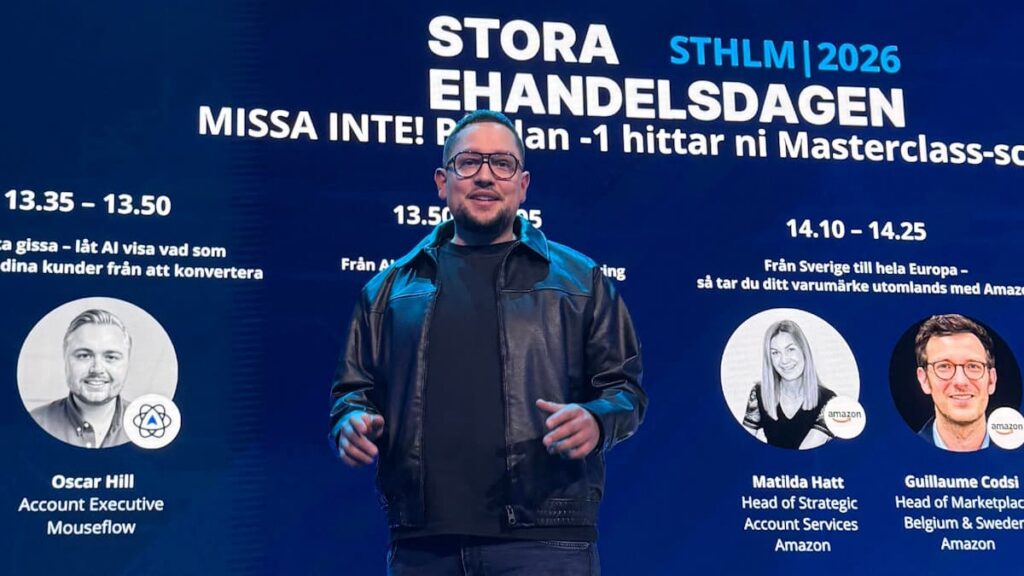
How exactly are Google's generative AI responses impacting Swedish e-commerce? A new measurement from the analysis company Castro AI attempts to answer this question. The study reviewed 77 Swedish e-commerce companies that participated in Stora Ehandelsdagen on Wednesday, using a data set based on just over 1.2 million keywords on desktop and 7.1 million monthly organic visits.
According to the measurement, Google's AI overviews now appear on a full 32 percent of e-commerce companies' keywords in Sweden, keywords that in turn account for 19 percent of the stores' total organic traffic. A keyword having an AI overview means that Google places an AI-generated summary at the very top of the search results, which means that the customer's question is often answered directly by the search giant before the visitor clicks through to an e-commerce site.
Zero correlation with good ranking
The most remarkable thing the report points out is that traditional search engine optimization does not seem to function as a shield. According to the measurement, the correlation between how large a share of keywords an e-commerce company has in the top three and how often AI overviews appear in practice is zero. Sites with absolute top placements are affected on average to the same extent as stores that rank lower, and according to the analysis, the size of the e-commerce company also has no decisive significance.
Many e-commerce companies believe that good SEO protects them from AI overviews, or conversely that good SEO gives them a place in them. The data says neither. Google puts the AI overview on the question, not on the winner, says Jorge Castro, SEO/GEO expert and founder of Castro AI.
Pharmacies and groceries hit hardest
When neither size nor ranking governs, the analysis instead points to industry affiliation as the decisive factor. Among the companies reviewed, the share of keywords with AI overviews ranges from 5 percent to as high as 91 percent, and for 14 of the 77 retailers, visitors are met with AI answers on more than half of the keywords. According to the report, actors in pharmacies, health and food are the hardest hit. At the top of the measurement we find, for example, Holistic where 61 percent of the keywords have AI overviews, closely followed by Meds at 52 percent, Fazer at 50 percent, Doz Apotek at 47 percent and Hemglass at 46 percent.
Even among the larger e-commerce players, clear differences are visible in the data. While SkiStar has AI overviews on 52 percent of its keywords and Hemköp is at 38 percent, it looks calmer for other companies such as Lyko at 22 percent, Cervera at 20 percent and electronics giant Power at 12 percent. At the very bottom of the measurement are pure fashion and brand stores. Despite strong organic placements, John Henric only has AI overviews on 11 percent of its keywords, Ideal of Sweden is at 10 percent and the stroller brand Bugaboo lands on 5 percent.
What determines it is what type of questions you live on. If you sell products that people ask questions about, such as dietary supplements, medicines or food, then the AI overview is already on a large part of your traffic. If you sell a brand, you are spared for the time being, but it is not your SEO that saves you, says Jorge Castro.
How to win visibility in the AI's brain
The question of how the new technology redraws the playing field on the web was one of the hot topics on Wednesday during Stora Ehandelsdagen 2026, where Jorge Castro participated on stage in the panel The new keyword battle: How to win visibility in the AI's brain.
In the panel, participants emphasized that even though traditional clicks may be challenged when Google changes the search experience, early experiences indicate that traffic that actually comes through AI tools can convert significantly better. Jorge Castro's conclusion to retailers is therefore not to rely solely on traditional SEO strategies, but to increasingly begin to structure and adapt their product and data flows for the AI models.