

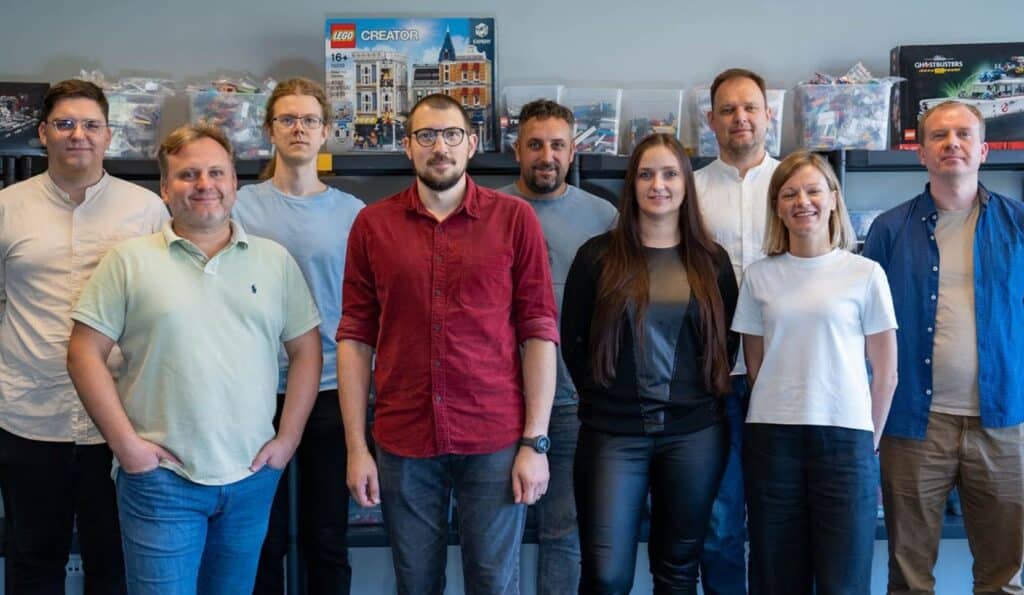
The idea for the company was born in 2022 out of sheer frustration, when one of the founders unsuccessfully tried to sort over 100 kilograms of mixed LEGO bricks at home. The realization that it was an impossible, never-ending project laid the foundation for the AI-powered solution that today employs a team of over 20 people in Vilnius.
Sort a Bricks business model rests on two pillars. Firstly, the company buys unsorted LEGO in bulk from private individuals, assembles complete LEGO sets using its AI sorter, and resells them via its own e-commerce platform.
The second part offers private individuals the opportunity to send in their own LEGO. The AI then analyzes which building sets can be recreated from the submitted bricks and sends them back, fully assembled. Customers can choose to sell any leftover pieces on the platform to reduce their total cost for the service.
Although the e-commerce platform is initially being rolled out throughout Europe with prices in euros, there is already a clear connection to the Nordic market.
Currently, the company has 27 Nordic customers, including 12 in Sweden, with a total of 420 kilograms of submitted LEGO waiting to be renovated.
Vinted Profiles Step In
In the latest funding round, Sort A Brick raised 2.35 million euros, equivalent to nearly 27 million Swedish kronor, to further develop its AI technology and scale up operations. And they are doing so with strong e-commerce profiles backing them.
Among the investors in the round is Mantas Mikuckas, co-founder of Vinted, who also acts as an advisor to the company. In addition, the LEGO platform's co-founder, Aurimas Slapšys, has a background at Vinted where he spent eight years in leadership roles.
And the Vinted legacy is partially reflected in the new company's strategy. According to the CEO, the platform has adopted Vinted's basic philosophy, but not copied its business model. Specifically, the biggest lesson they are taking with them is that used goods must be cheap and easy to buy; the sustainability argument alone is not enough.
Therefore, Sort a Brick has chosen to keep prices as low as possible, rather than maximizing profit on each individual building set.
We embrace that mindset, but not the model. Vinted is a software-based marketplace; our infrastructure is a mix of hardware, software, and physical AI that transforms piles of unsorted LEGO into complete sets ready to be resold, says Ilya Malkin.
But before the used LEGO bricks can be resold, they must pass through the facility in Lithuania.
Three Steps Through the AI Machinery
The core of the business, and the biggest challenge, is to sort the large amount of mixed pieces quickly and accurately. To succeed in this, the company has, as previously mentioned, developed its own AI sorting machine that works in three steps: feeding, recognition, and sorting.
First, all the LEGO bricks are washed at low temperatures, and then the piles are broken down into a steady flow of individual parts. Then, image recognition takes over to handle the variation in shapes, weights, and materials.
Cameras capture each brick from all angles simultaneously, and our own image recognition identifies it by shape, color, and any pattern, says Ilya Malkin.
According to the company, the machine is accurate to 99.8 percent, as it analyzes all sides of the brick at once.
In a final step, the system compares the scanned pieces to lists of all LEGO sets ever produced. Then, each brick is automatically sent to a designated container. The machine can handle approximately 1,000 pieces per hour and requires only one person to load and unload the material.
But before the complete building sets are put up for sale in the e-commerce store, an important detail is added. The platform does not use official "stock images" from LEGO. Instead, each unique set is photographed so that customers can see which pieces they are buying and if there are any discolorations, scratches, or glue residue remaining after they have been washed.
In addition, the company provides a guarantee that each delivered set is one hundred percent complete and contains only genuine LEGO bricks.
No Need to Pay for Air
Building an international e-commerce business that relies on shipping goods across borders presents logistical challenges for both profitability and the environment. Since all sorting currently takes place centrally in Lithuania, transportation is a key issue.
Surprisingly, LEGO bricks actually fit perfectly for parcel shipping, says Ilya Malkin.
When the company buys loose bricks from private individuals, the material is packed so tightly that it contains almost no air at all, making shipping cost-effective.
We pay for very little empty space, and we apply the same logic when sending out goods: most renovated sets are packed in bags instead of the usual cardboard boxes.
This means that shipping accounts for a very small part of the final price of the building set. At the same time, it reduces emissions – fewer packages and less air simply mean fewer kilometers driven per kilogram of LEGO bricks.
Swedish Launch Requires New Milestones
Although the packages are currently traveling smoothly across the Baltic Sea, the company is looking towards the Nordic customers who are queuing on the waiting list. But taking the step towards a full-scale Swedish launch with local currency, an adapted website, and a Swedish warehouse is not something that happens overnight.
For Sort a Brick, a local presence is primarily about moving the handling closer to the buyers.
Right now, all sorting takes place in Lithuania where our automation is located. But if the Nordic volumes grow sufficiently, the next step will be a local sorting center there, says Ilya Malkin.
The Swedish enthusiasts on the waiting list will therefore have to wait a little longer while the company builds up the operational muscles required for the next big leap.
The Nordics are definitely one of the markets we want a greater presence in, but we still need to reach some other milestones before we can think about a more concrete timeline. Hopefully, the wait won't be too long, concludes Ilya Malkin.