

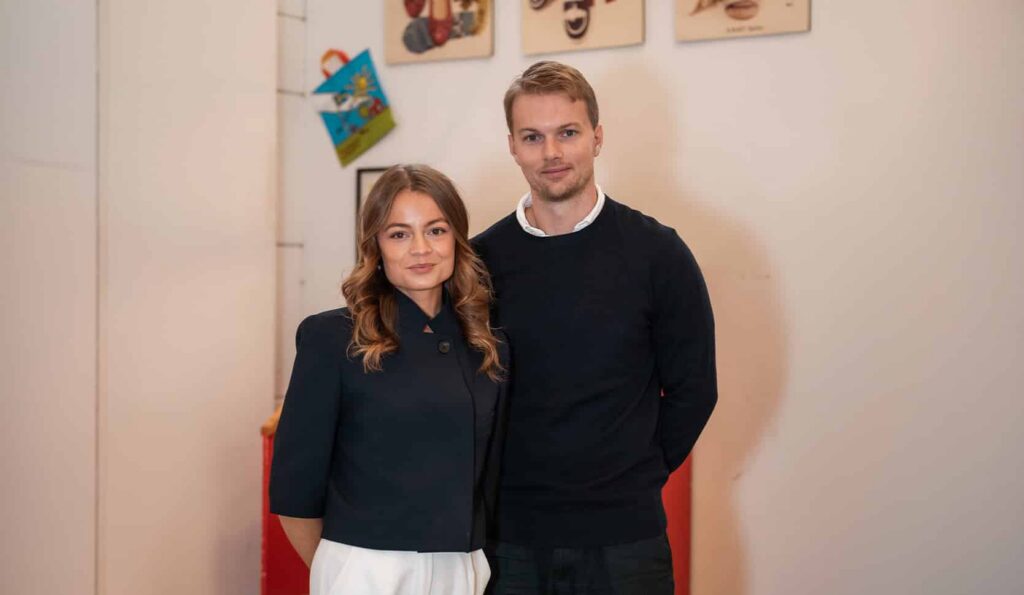
The decision to acquire the company evolved over time. Both Erik Thyrelius and Stina Aronsson have worked within the company for a long time and have insight into the business. The step from employees to owners therefore felt like a natural path forward.
We both know Kavat very well. We have worked together in the company for several years, says Erik Thyrelius and continues:
Together we came to the conclusion that we want to invest. If we don't dare take the chance now, we will probably regret it later. Of course, it's very fun, but above all, we feel a great responsibility.
Kavat was founded back in 1945 and the company is today a workplace for many people. Taking over a company with that background entails responsibility.
That is something we have great respect for, he says.
When it comes to the exact distribution of shares, the duo chooses to keep the figures to themselves. It is clear, however, that they jointly hold the majority of the company, and that the former CEO remains in the background.
We don't want to go into the exact ownership share. Stina and I are together the majority owners, says Erik Thyrelius and adds:
But we can confirm that Magnus, the company's former CEO, is still a shareholder.
Even though the names on the ownership list have changed, work in the office will continue as usual. There will be no new titles on business cards, with both Erik and Stina retaining their current desks and responsibilities. However, the perspective on the decisions made will change.
We will continue in our operational roles as CEO and Sales Manager respectively. The big difference, of course, is the ownership perspective, says Erik Thyrelius.
We have already had a great deal of responsibility in the business, but as owners, the time horizon becomes even longer and the connection between decisions, risk and consequences even clearer.
Financials and the path to profitability
The last few years have been marked by financial challenges for the shoe manufacturer.
According to the annual report for 2024, turnover decreased by 8 percent to SEK 68.7 million, compared with SEK 74.7 million the year before. Operating profit was also down, amounting to minus SEK 6.4 million, compared with minus SEK 4 million in the previous year.
As the annual report for 2025 has not yet been published, Ehandel.se asks how the last financial year went. The answer hints at a continued period of restructuring.
2025 was still a tough year for Kavat and was characterized by the transformation the company was undergoing. We do not want to anticipate the formal annual report by communicating exact figures before it is published.
However, the CEO does not hide the fact that the goals for last year were not reached, but he also sees a turnaround on the horizon thanks to the measures taken.
We can state that we are not satisfied with the result in 2025 at all. What is important to us is that several of the measures implemented during 2025 have laid the foundation for the clear improvement we are now seeing in 2026.
Much indicates that the hard work is starting to bear fruit now that the business is well into 2026.
The development is clearly moving in the right direction. The result has improved significantly compared to the previous year and our current forecast implies a profit improvement of several million kronor for the full year 2026, he says.
We also see several positive underlying signs. We sell a larger proportion from the regular collection and less on sale, while we have continued to work on stocks and costs.
Now the focus is on achieving black figures.
We have learned to never take anything for granted, but we feel confident that we are doing significantly more right than wrong right now. Our goal is for Kavat to be profitable in 2027.
Focus from restructuring to development
One step in turning the ship around has been to scale down and streamline. Own manufacturing in Bosnia has been closed, as have several stores, in order to build the company on a narrower and more focused business model.
Kavat has concentrated its operations in recent years. We have gone from own shoe manufacturing and several own stores to a much more focused business, he says.
Erik explains that they now want to allocate resources to other parts of the business.
Now we want to shift more power from restructuring to development. In the short term, it is largely about continuing to improve product, purchasing, stock, quality, e-commerce and cost structure.
They also plan to invest in the brand and range.
We also want to spend more time on design and product development, new materials and techniques as well as relevant collaborations. In the long term, the ambition is quite simple: Kavat should become a larger and profitable company with shoes that even more children and adults love.
The balance between e-commerce and physical retail
Sales currently take place through several different channels, and that strategy is here to stay. Even in a digital world, the new owners see that the classic stores fulfill a function.
E-commerce is an important part of our core business and an area we need to continue to develop. At the same time, we strongly believe in our retailers, says Erik Thyrelius.
Especially when it comes to children's shoes, the physical stores fulfill a specific function for consumers.
Children's shoes are a product where many customers still appreciate good advice, the opportunity to measure feet and be able to try on the shoes. Therefore, we do not see e-commerce and physical retail as an either/or.
Rather than letting e-commerce and physical retail fight against each other, Kavat sees the two legs supporting the company in different ways.
Our own e-commerce gives us the opportunity to offer the entire brand and have a direct relationship with the customer, while skilled retailers give Kavat local presence and reach customers in a way we could never do ourselves.
When it comes to the stores that the company operates itself, the focus in the future will be on home ground.
Regarding our own physical stores, we will focus and develop our large store in Kumla going forward. We want to make the store a destination in Närke. We also want to emphasize that in Kumla we continue to buy back old Kavat shoes to demonstrate a circular business model.
The future of the brand
Now that the takeover is official, the responsibility for Kavat's future lies with Erik Thyrelius and Stina Aronsson. Taking on that role brings mixed feelings.
It's a mix of pride, joy and quite a bit of respect for the task, he says.
We meet people who say they "only buy Kavat" and retailers who have sold our shoes for generations. Then there are all the fantastic colleagues, suppliers and other people we work with every day.
Taking over a shoe company that has been around for so long is something he sees as a major commitment.
Becoming a majority owner of, and managing, a Swedish brand with such a long history feels very big. Now it is our responsibility to develop Kavat further and do everything we can to make the future as impressive as the history.
What is your biggest common goal now that you take over the helm?
To manage Kavat by developing it. We want to make even better products, build a stronger brand and create a long-term profitable company, says Erik Thyrelius and concludes:
There is a lot in Kavat that is timeless. Good children's shoes of high quality were relevant 40 years ago and are just as relevant today. At the same time, we cannot believe that everything that brought Kavat here will take us through the next 80 years. We want to protect what is really good and at the same time have the courage to change what needs to be better.