

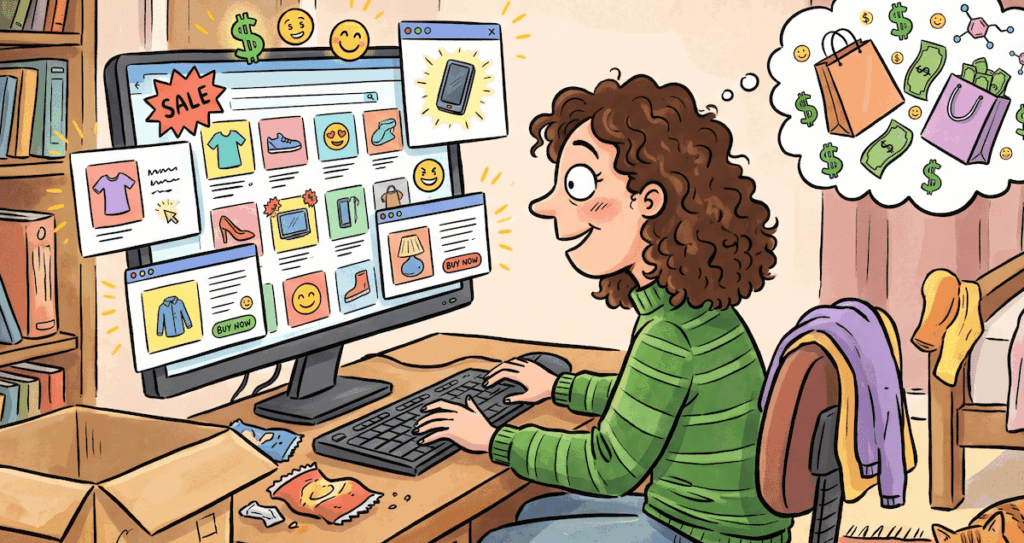
An example of this new phenomenon is websites like dopamineshopping.com or apps such as FakeEats. These websites simulate the entire e-commerce or food delivery experience in detail. Consumers can browse products, read customer reviews, add items to a shopping cart, and finally click the purchase button. Some platforms even include a fictional tracking map where the customer can follow a virtual delivery all the way to their door. The difference from traditional e-commerce is that no money is drawn from any account, and no goods are delivered.
The Psychology: Reward Without Transaction
For e-commerce businesses, the business model is based on conversion, but for the brain's reward system, the purchasing process itself is often sufficient to create pleasure. The human brain has a reward system that provides dopamine kicks when we satisfy our needs, and consumption is one such learned behavior.
Research shows that the anticipation of a product often triggers a stronger reward response than actually receiving the item. According to media reports, simply imitating the act of scrolling through a selection, adding an item to the cart, and clicking the order button is often enough to evoke the same satisfaction as an actual purchase.
Originating In South Korea
The trend, often referred to as "dopamine sites," has gained traction among the young generation (Gen Z) in South Korea. The phenomenon is described as a reaction to high living costs and constant pressure to consume.
Through these sites, users can experience the digital atmosphere and ritual of a purchase without building up financial debt. Kim Heon-sik, a professor at Jungwon University, explains that the development is linked to an online culture built on constant stimulation.
These websites also reflect a desire to experience similar satisfaction or atmosphere without participating in real life, says Kim Heon-sik.
He also notes that the trend reflects fatigue and anxiety among young people.
This is an era characterized by uncertainty about the future and burnout, he says.
An Alternative To "Doom Spending"
Dopamine sites can be seen in the context of another well-documented consumer behavior: "doom spending". This concept is defined as impulsive purchases driven by fear and anxiety about the future. According to a 2025 report, 19 percent of adult Americans stated that they engaged in this behavior.
This type of consumption is often driven by macroeconomic uncertainty, such as concerns about inflation or new tariffs. The downside of "doom spending" is that it drives up household debt. From this perspective, fake stores function as a method for users to manage their shopping urges and dampen stress without resulting in financial consequences.
More Than Just A Transaction
The development clearly shows that e-commerce and consumption today are about much more than the physical exchange of goods and money. A variety of psychological factors are involved, and shopping has demonstrably grown into a central part of how people manage both emotions and stress in everyday life.
As the Finnish public service channel Yle previously highlighted, today's consumption culture is largely a learned behavior where the brain's reward system quickly associates online shopping with short-term well-being. In that light, the emergence of dopamine sites is a logical receipt that we are now often driven by the ritual of shopping, rather than an actual need for the final product.