

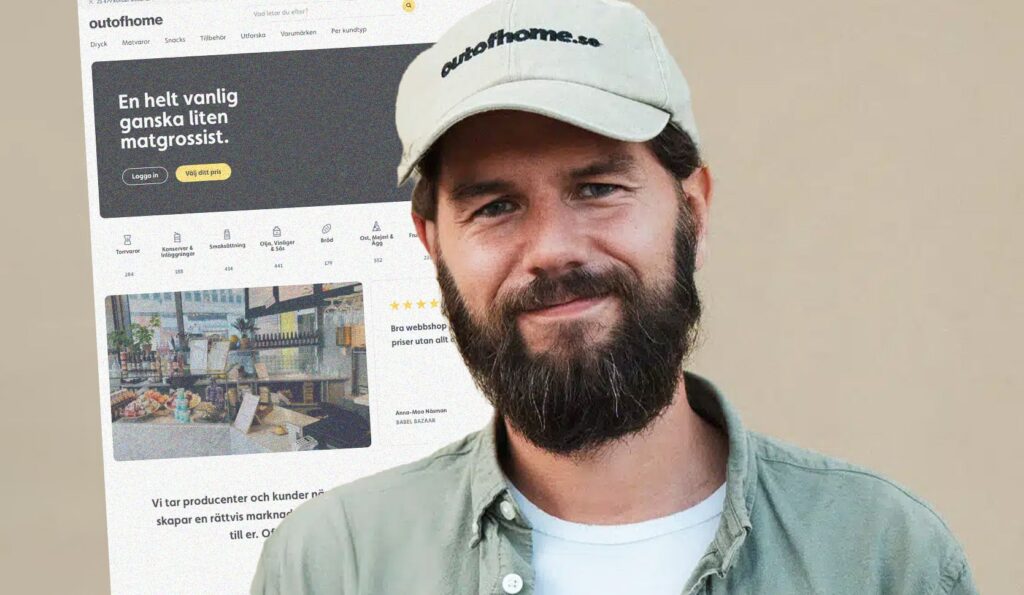
Outofhome sells food to restaurants, hotels and offices, and currently 80 percent of the company's sales are made via e-commerce. Unlike many established players in the industry, who have historically relied on things like product catalogs in PDF format, the company early on chose a digital path. To build up its visibility on Google, CEO Jacob Hillestad has personally formulated thousands of unique product descriptions in the company's online store. A strategy was designed as a direct counter-reaction to how the wholesale market usually works on the internet.
"Often, wholesalers only have a closed webshop without both images and prices," says CEO Jacob Hillestad, to the site.
Growth and Focus on Profitability
The company has had steady financial development since its start in 2015, when they had a turnover of 6 million Swedish krona. The financial statements for last year show a turnover of 453 million Swedish krona, which is an increase of 25 percent.
An exact operating profit for these years does not appear in the material, but the company has now shifted its focus from solely growth to profitability. For the current year, the budget is set to a turnover of half a billion Swedish krona, with the goal of reaching a positive operating profit.
In the autumn of 2024, an acquisition of a company in Växjö with a focus on fresh produce was carried out, which has been integrated into the business to broaden the range. Around 2021, the company considered an IPO, but these plans were paused when the climate for investments in B2B sales shifted from rewarding revenue growth to demanding profits.
Today, the company's focus is entirely on building a profitable business model, while continuing to gain market share month by month.
"Currently, there is no need to raise additional capital, even though we could then grow much faster. But in February alone, growth was over 28 percent organically, so we are not complaining," says CEO Jacob Hillestad.