

Since Google's AI-generated responses, AI Overviews, began being secretly tested and rolled out in Sweden during 2025, the e-commerce industry has been trying to understand how the new technology impacts the customer journey. Historically, commercial shopping searches have been relatively protected from AI responses compared to pure informational searches, but in 2026, the AI function has seriously entered transactional search results.
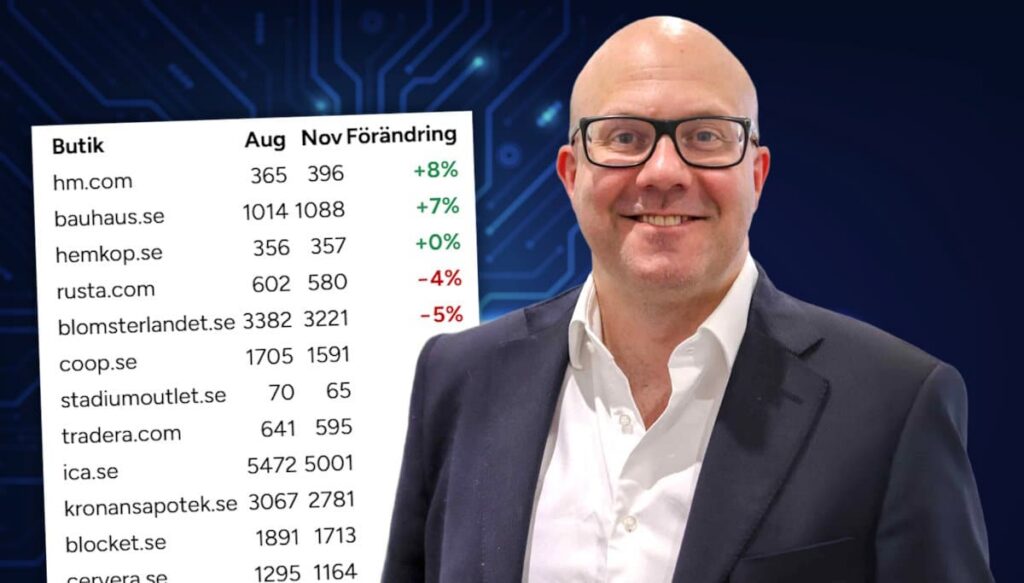
Now, a new mapping from the SEO agency Topdog, which analyzed data from Ahrefs Brand Radar in early November, shows how Sweden's 50 largest e-commerce companies (measured by organic search traffic) are cited as sources in Google's AI Overviews.

Between May and November 2026, the number of citations for the 50 e-commerce companies has increased by a total of 44 percent, and 49 of the 50 stores examined are now more visible than they were in May.
Sharp Turn After Peak in August
But behind the overall increase lies a sudden trend reversal. The peak was reached in August, and since then, citations of the Swedish e-commerce giants have decreased by 17 percent to November. The decline is broad and affects 45 of the 50 analyzed stores.
Among the players that have lost the most visibility in AI responses since August are Stadium with a decrease of 48 percent, followed by Hemtex which has fallen by 33 percent and Prisjakt with a drop of 29 percent. Even heavyweights such as Granngården have decreased by 27 percent, Kicks by 25 percent, while Elgiganten, Clas Ohlson and Ikea have all lost 22 percent of their citations each during the same period.
When Ehandel.se asks Christian Rudolf, CEO and founder of Topdog, why the curve suddenly turned downwards in August, he states that the pattern is puzzling.
It's a really difficult question. I formulated several hypotheses yesterday because the turning point feels illogical, but none of them held up completely. My personal speculation is that it has something to do with Google's revenue – they are extremely sensitive to disruptions there. At the same time, it is just a speculation, because I do not see the direct connection between Google AI Overviews and their advertising revenue. If there had been such a conflict, it should have become apparent much earlier.
More Direct Clicks – But More Chaotic Customer Journey
The fact that e-commerce companies are cited less often in AI responses during the autumn does not necessarily have to be a disaster for actual traffic to the online stores. On the contrary, it may mean that more consumers are clicking on the classic search results again. At the same time, the playing field is changing for how e-commerce companies measure and understand their visitors, says Christian Rudolf.
Fewer AI Overviews generally mean more commercial clicks directly to e-commerce companies. Conversion is, of course, another matter, but commercial searches are usually made with purchase intent. Therefore, I do not think the demand will decrease, but the customer journey will become significantly more chaotic from the e-commerce company's perspective. It will be more difficult to track exactly how the visitor found the store. When fewer clicks go through an AI Overview, the user may instead land on the site via, for example, a brand search a step later.
Giants Going Against the Trend
Despite the broad mass of Swedish e-commerce companies having lost visibility in AI Overviews since late summer, there are a few clear exceptions. While Hemköp remains at an unchanged level, fashion giant H&M has increased its citations by 8 percent since August, and building materials warehouse Bauhaus has climbed by 7 percent.
Previously, SEO experts have highlighted the importance of content depth to rank high with AI, and according to Christian Rudolf, it is precisely systematic work with the range that lies behind H&M's and Bauhaus' resilience.
The most likely explanation is that they are actively expanding the content on their sites. They are rolling out more products, more variants and building out the depth in a very consistent and significant way.
Expert Advice Ahead of Christmas Shopping and 2027
Now, Swedish e-commerce companies are facing the most important sales period of the year, while eyes are already turning to 2027. For the retailers who want to secure their visibility – both in traditional search and in Google's AI functions – Christian Rudolf strongly advises against wild gambles at the eleventh hour.
There is far too little time left until Christmas to experiment, so my advice is to focus on classic SEO. What gives the best effect in relation to the work effort is to broaden the range if possible. More products not only strengthen organic visibility, but also lift the shopping feed that drives Google Ads and future AI searches. You should also clean up the site from duplicate content and remove unnecessary duplicate content that dilutes your ranking.
In addition to range width and technical cleaning, he points to a completely basic discipline that many online stores still neglect in everyday life, but which has gained a new strategic importance as AI search reads the retailers' product data.
Optimize Title, Description and H1. These are the elements customers see in search results when they choose where to click. Surprisingly often, this is overlooked at the product level by e-commerce companies. Going through and sharpening them not only strengthens SEO, but also optimizes product flows for shopping and AI SEO, as AI checks the feeds, says Christian Rudolf.