

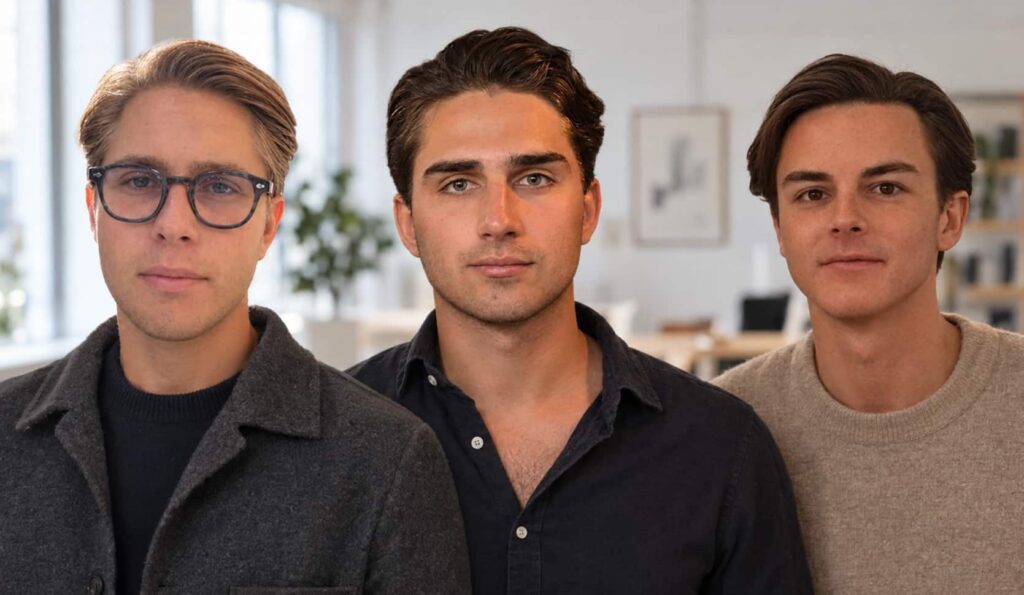
Carl, Gustav and Hugo found each other during their time at Sigtuna Humanistiska Läroverket school. With a shared interest in e-commerce, they had previously experimented with small-scale dropshipping, which gave them a basic understanding of driving digital traffic.
We quickly felt that dropshipping lacked the long-term sustainability we were looking for. We wanted to build a real brand that we could stand behind and have control over the entire chain, from design to customer experience," says Carl Milio Andrée.
But the step to building their own brand with physical inventory and supply chains was taken through an unexpected initiative.
One of the friends was a customer of the Swedish sneaker brand Bivando and often received questions about where the shoes came from. When they researched the company further via Allabolag, they discovered that turnover was relatively modest, despite a product they considered strong and high quality.
The company was not for sale, but the trio still chose to send a spontaneous email.
We noticed that the shoes often received compliments. When we looked up the company, we saw the potential. We simply decided to email the owner to see if there was any interest in selling," says Carl Milio Andrée.
In August 2025, the transfer of business was completed, entirely financed with private funds.
We saw great value in the fact that there was already a foundation to build on, with a finished product, existing customers and, not least, established relationships with suppliers and manufacturers," says Gustav Sandin.
The challenge of inheriting a brand image
Taking over Bivando meant not only managing suppliers, but also taking care of an already established brand image and customer base.
The biggest challenge has been inheriting an existing image, as opposed to starting with a blank slate. It's about finding the balance between what should be retained and what should be changed without losing what actually worked before," says Hugo Lagerling.
In addition, we took over an inventory where men's sizes were practically sold out, which meant we quickly had to adapt our strategy and initially focus heavily on the women's segment before we could replenish stock," adds Gustav Sandin.
The first financial year was characterized by restructuring. The annual accounts for the period February 17th to December 31st, 2025 show a turnover of just over 32,000 Swedish krona and a result after financial items of minus 34,000 Swedish krona.
The loss during the shortened financial year was partly due to the founders choosing to write down the value of the inherited inventory to an estimated market value.
However, the path to the relaunch was not straightforward. The founders are self-critical of the start and the ambition to do everything at once without proper prioritization.
We got bogged down in making the products and website perfect behind closed doors. We should have started marketing and building an audience in parallel from day one instead of waiting until everything was completely finished. When we took over, there was so much we wanted to change that we tried to do many things at the same time," says Carl Milio Andrée.
In 2026, the company launched a new e-commerce platform and introduced new shoe models. Despite initial delivery delays at the beginning of the year, sales have picked up.
Despite the delivery delays at the start, turnover so far in 2026 has increased by approximately 330 percent compared to 2025, and we have managed to maintain a positive result while investing in the business," explain the trio.
The business is now run with a positive result, with the surplus being fully reinvested in inventory, office space and continued expansion.
Focus on everyday life instead of quick clicks
Entering the shoe industry means facing global giants with million-dollar budgets. For three 20-year-olds, there was no opportunity to buy their way to success through expensive advertising campaigns, so they had to find other ways to reach out through organic visibility, UGC and Tiktok.
The marketing strategy therefore relies heavily on organic content. Instead of chasing immediate conversions, they build the brand by showing the product in its natural environment.
We don't focus on short-term conversion clicks. We want to show the shoes styled in everyday life by real people to build long-term trust and recognition," says Gustav Sandin.
Despite the progress with moving content, the trio is also humble about the challenge.
We haven't yet found a single strategy that consistently delivers the best conversion, but we are still in a phase where we are testing things out. Our long-term ambition is to build a brand that people discover and want to be a part of, rather than being completely dependent on paid advertising," explain the founders.
The strategy has resulted in an average customer acquisition cost (CAC) of around 500 Swedish krona. To keep return rates down while maintaining a good customer experience, they actively work with clear size guides and offer free size exchanges.
The goal is to convert a potential return into an exchange and thus retain the customer.
Shoes online are special because the fit is so individual. By offering smooth and free exchanges, we lower the threshold for the customer to dare to try, which saves many deals from ending in a pure return," says Hugo Lagerling.
The focus is on turning a mistake into a loyalty factor.
For us, it's not just about keeping down the costs of returns, but also about building long-term customer relationships. A smooth experience, even when something didn't go right from the start, increases the chances that the customer will choose to shop with us again," he continues.
Expanding the range and looking ahead
With a growing customer base and valuable lessons learned, the trio is now looking ahead to new milestones.
Our goal for 2026 and 2027 is to expand the range and develop more models that have a clear character of their own, but which also maintain high quality at a reasonable price. We don't think that a unique and well-made product necessarily has to cost as much as it does. For us, it's about continuing to be consistent and gradually building a brand that more and more people know," concludes Carl Milio Andrée.