

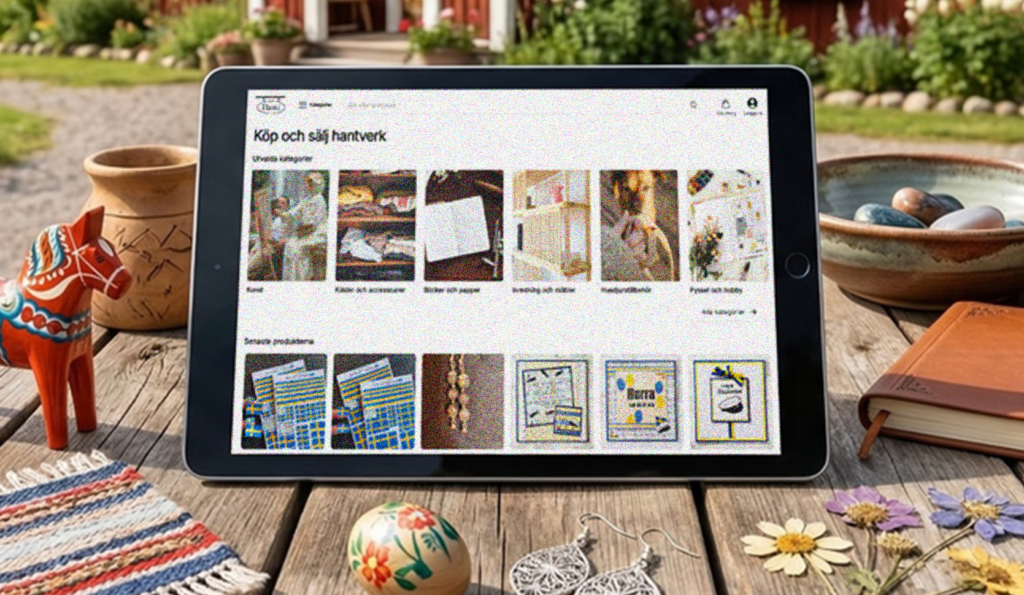
Andreas and Rikard Teodorsson jointly run the platform, with the technical operations based in Kungsbacka and Östersund. The initial idea for the business arose from a personal need rather than a pure business plan.
Both brothers share an interest in creating with their hands, in their case primarily through art and handmade dog accessories, but when it came time to try to reach customers with their goods, the Swedish market echoed empty for customized digital solutions that suited their specific needs.
We are both interested in crafts and have a background in information technology and programming. We started Hanti because we ourselves lacked a Swedish site to sell handmade products on, says Rikard Teodorsson to Ehandel.se.
Reaching Out Through the Noise
Over the past year since the doors opened, the assortment has expanded to over 2,500 unique items. Hanti has chosen to completely refrain from paid product placements and search algorithms that control who is most visible, in order to allow all creators to meet customers on exactly the same terms.
The development of the number of users is progressing, but establishing a completely new brand from scratch involves challenges. The primary obstacle right now concerns visibility and making the platform known to the general public.
Since the launch just over a year ago, the number of users and sellers has grown slowly but steadily, says Rikard Teodorsson and continues:
From being completely unknown to now having a couple of hundred private individuals and small business owners selling their own crafts, we see this as a sign that there is interest in such a site. Our biggest challenge is marketing, reaching out to let people know the site exists and attracting both sellers and buyers.
Challenging the International Companies
The company explicitly positions itself as a domestic counterpoint to global players such as Etsy. To attract creators from international platforms, the brothers have formulated a business model based on transparency and fewer financial barriers.
Another side of the company's independence is the choice of technical infrastructure, where the ambition is to disconnect from foreign cloud services as much as possible. Instead, the servers are run locally and on completely renewable energy.
Hanti has low and simple pricing. The fee for selling on Hanti is only 5 percent of the order amount plus a transaction cost, no other fees, says Rikard Teodorsson.
In addition, the site is easy to use and almost completely independent of large tech companies. As much as possible, we operate everything within Sweden or the EU on our own servers.
In addition to low fees and independent technology, the digital threshold for getting started is another part of the strategy to attract sellers. Because creators often want to spend their time on the creation itself rather than navigating technical systems, the brothers have utilized their background in systems development to build an uncomplicated interface.
A great focus is on user-friendliness, the site needs to be as simple as possible to use, says Rikard Teodorsson.
Handmade as a Counterweight to Mass Production
In an e-commerce climate where several niche players have struggled to make the economy work, demands are placed on endurance. To build a business model that works over time, the founders focus on a few specific core areas. This concerns the technical experience on the site, but just as much about consumers' security and the desire to offer pure alternatives to factory-made goods.
We are working to get more buyers and sellers to Hanti, and to build trust so that users feel safe shopping on the site. Hopefully, our site is interesting enough for customers, as we are a place where you can find unique crafts from local creators, in contrast to much of the mass-produced goods that are otherwise sold, says Rikard Teodorsson.
To ensure that the range lives up to this, and is not filled with mass-produced goods, the rules for sellers are clearly defined. No requirements are placed on having a registered company to join the service, but the platform strictly adheres to the rule that the products must be created by the seller himself.
We virtually prevent no one from selling on Hanti as long as they sell their own crafts.
Looking Towards Europe
Although the platform's focus so far has been exclusively on the Swedish market, the technology is being prepared to handle transactions and logistics outside the country's borders. This gradual expansion will initially allow Swedish traders to test foreign markets, in order to later open the entire platform to international sellers. However, the flexibility for the individual creator remains at the center.
First, we will open up for sales within the EU for the sellers who want to sell abroad. Thereafter, we are considering allowing sellers from all over the EU - so that we reach a larger market with both buyers and sellers. Sellers will be able to decide for themselves to which or which countries they sell to.
Before the establishment outside of Sweden can gain momentum, the company needs to secure its core business at home. When asked about what financial goals the founders have during the initial period of operation, the answer is scaled down and pragmatic:
It would be nice to generate enough revenue to cover our operating costs, concludes Rikard Teodorsson.