
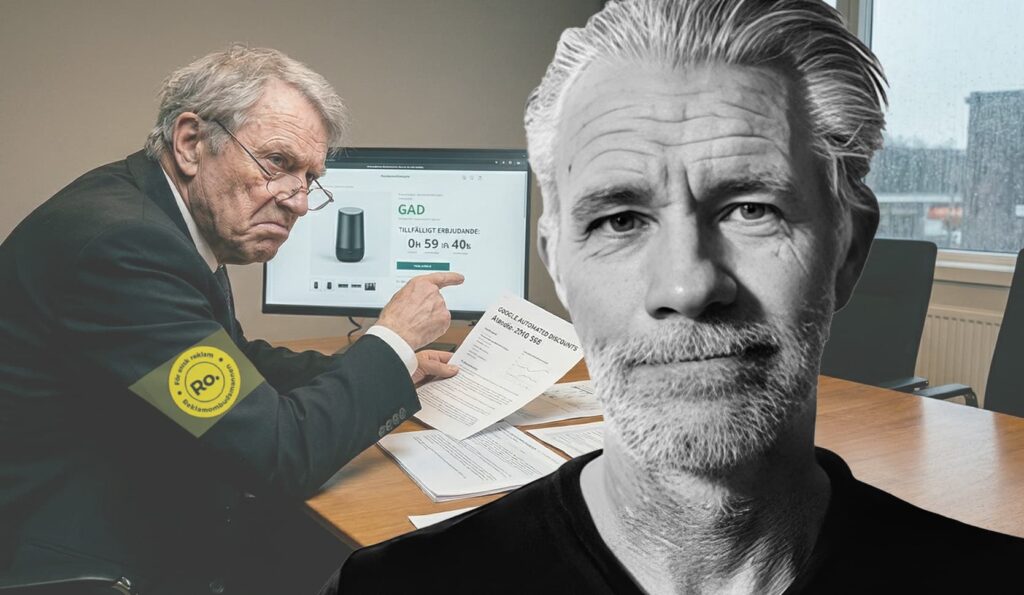
Last spring, the debate surrounding Google Automated Discounts was current. The function allows algorithms to adjust prices in ads to meet customer demand.
Several e-commerce companies were quick to integrate the solution to drive sales, and the Swedish Consumer Agency clarified at the same time that the responsibility lies with the e-commerce company. Simply put: If the company cannot account for the lowest price over the past 30 days, the method should not be used. Google subsequently updated its system to retrieve price history, but emphasized that the e-commerce company bears full responsibility for complying with the law.
Now the matter has been tried from another perspective, namely how the offer itself is presented.
A private individual reported Bangerhead to the Advertising Ombudsman. On the e-commerce company's website, a skincare product was displayed for SEK 250, with a regular price of SEK 333. Below the price was a box with the text that it was a temporary offer, followed by a countdown timer starting at 60 minutes.
The complainant reacted to the fact that the campaign was not time-limited as promised. When the customer visited the website at a later time, the product was still available at the same discounted price, and the clock started counting down from 60 minutes again.
Ruling from the Advertising Ombudsman
In its initial statement, Bangerhead explained that the price and clock were generated automatically via the function from Google. The company does not perform any manual pricing when the function is active.
Google technically requires that a displayed price must be valid for at least 30 minutes, and Bangerhead set this time to one hour.
However, the Advertising Ombudsman's opinion council focuses on the consumer experience and assesses the advertisement based on how an average consumer perceives the message. The council believes that a customer will likely interpret the countdown as meaning that the price only applies during that hour.
Since the price was still available later the same day with a restarted timer, Bangerhead is ruled to be misleading and in violation of Article 5 of the International Chamber of Commerce's rules.
Ehandel.se contacted the Advertising Ombudsman to ask how they view the dynamic aspect and whether different text next to the clock would have acquitted the e-commerce company. Peter Knutsson, advertising ombudsman, explains that they try complaints based on specific cases and do not give prior notice about "theoretical" setups.
Since the council is a reviewing instance, we do not have the opportunity to speculate on how the council would assess other types of advertising or content that has not been tried, he says.
Demanding an Industry Standard
When Ehandel.se reaches Johan Widström, CEO of Bangerhead, the company stands behind the council's decision. He explains that they have had technically correct pricing, but that they realize how the communication can be misinterpreted by consumers and does not fully reflect how dynamic pricing works in practice.
We respect the Advertising Ombudsman's decision and take note of their assessment, says Johan Widström.
He further highlights the dilemma for today's e-commerce companies. Systems are controlled by global platforms and optimized in real time.
This highlights a major shift in e-commerce, where prices are increasingly set dynamically via platforms such as Google and optimized in real time. This essentially means that we can no longer offer the customer fixed prices and cannot control the prices either. Nevertheless, the responsibility for how the prices are communicated still lies with us, says Johan Widström and continues:
That is where the challenge arises, and where we need to be clearer.
To manage this challenge in the long term, the company is now calling for guidelines that the entire market can relate to.
The decision shows that the responsibility falls on the retailer regardless of technology, which the CEO sees as an important principle, but at the same time it points to a larger industry issue.
When pricing in practice is controlled by external platforms, while the responsibility is local, we must agree on an industry standard so that customers experience some kind of consistency and have confidence. We see a need for clearer practice and guidelines for how dynamic pricing is communicated to consumers. Our hope is that the industry will agree on a way forward, he says.
Will Continue Using the Tool
Despite the ruling and the ongoing debate surrounding the issue of responsibility, the company will not back down from using the technology.
Johan Widström is clear that dynamic pricing is a model they will retain going forward.
Automated pricing is now an established part of e-commerce and will continue to be so. We continue with Google Automated Discounts. Our focus going forward is to ensure that the customer experience is completely transparent and understandable even when the underlying technology provides a new type of pricing, concludes Johan Widström.